
Foot Pain Physiotherapy in Singapore
Information reviewed by: Dr Foo Gen Lin | Last updated:
Heel, arch, or ball-of-foot pain that flares every time you stand or walk? At Apex Sports Clinic, we identify why the tissue became painful and build a treatment plan around it, often starting with physiotherapy, so you can get back on your feet comfortably.

MBBS (University of London) | MMed (Ortho) | FRCSEd (Ortho) | FAMS (Ortho)

How Physiotherapy Helps Relieve Foot Pain
Physiotherapy can help relieve foot pain by reducing the load on the painful tissue, increasing how
much activity the foot can tolerate, and correcting the movement patterns that contributed to the
problem.
Your feet absorb your body weight several thousand times a day, which is why foot pain often does
not settle with rest alone. How the foot is used and supported usually needs to change.

Physiotherapy for foot pain typically works towards outcomes such as:
- Reducing pain and morning stiffness
- Strengthening the small muscles inside the foot along with the calf and hip muscles above it
- Restoring movement at the ankle and toes
- Correcting how your foot contacts the ground when you walk or run
- Lowering the risk of the same problem returning once you resume full activity
Foot and Ankle Physiotherapy at Apex Sports Clinic
Foot and ankle physiotherapy at Apex Sports Clinic begins with identifying why the tissue became
painful, not just where it hurts. That diagnosis determines your treatment plan, along with your
activity level and recovery goals.
Treatment follows three stages:
1. Comprehensive Foot and Ankle Assessment
A review of your symptoms, medical background, footwear, and activity, with a physical examination of the foot and ankle. Where symptoms relate to walking or running, gait analysis, a study of your walking pattern, can show problems a static examination cannot. Imaging such as an X-ray, ultrasound, or MRI is arranged if a fracture, tendon tear, or other structural problem is suspected.
2. Personalised Rehabilitation Plan
An individualised programme combining exercise, manual therapy, footwear guidance, and activity pacing, with shockwave therapy added for longer-standing symptoms. If your foot requires a specialist opinion, we can arrange an internal referral to our orthopaedic specialist, without the wait for an external appointment.
3. Ongoing Support and Progress Review
Progress is reviewed at each visit and the programme adjusted as your foot tolerates more activity, supporting a return to standing at work, walking normal distances, or training without symptoms.
Meet Our Physiotherapist

BSc (Physiotherapy) (Hons I), Curtin University
Fully Registered Physiotherapist (AHPC, Singapore)
Languages: English and Mandarin
Sarita is a senior physiotherapist who treats musculoskeletal injuries
across all ages and activity levels.
She focuses on identifying the root cause of symptoms rather than treating pain alone,
with a particular interest in post-operative rehabilitation and exercise-based therapy.
Working alongside the orthopaedic and sports medicine team at Apex Sports Clinic, she
helps patients recover and return confidently to the activities they enjoy.
Common Foot Pain Conditions We Manage With Physiotherapy
Foot pain has three main causes: tissue loaded beyond its current capacity, injury to bone or ligament, and problems with the structure and mechanics of the foot. Common conditions include:
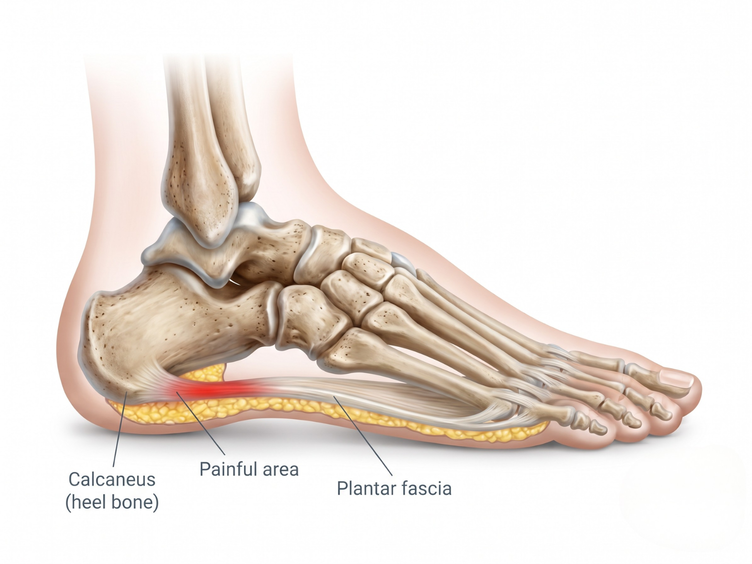
Plantar Fasciitis and Heel Pain
Plantar
fasciitis is irritation of the plantar fascia, the thick band of
tissue running along the sole from your heel to your toes. It causes sharp
heel pain with your first steps in the morning or after sitting, which eases
as you keep moving and returns later in the day.
Plantar fasciitis is the most common cause of heel
pain in adults and often follows an increase in walking or running,
long hours of standing, weight gain, or a change of footwear.

Achilles Tendinopathy
Achilles tendinopathy is
irritation and gradual degeneration of the Achilles tendon, the cord
connecting your calf muscles to your heel bone. Pain sits at the back of the
heel or a few centimetres above it, is worse first thing in the morning,
eases during exercise, and returns afterwards.
It commonly affects
runners, people who have recently increased their training, and
those returning to sport after a break.
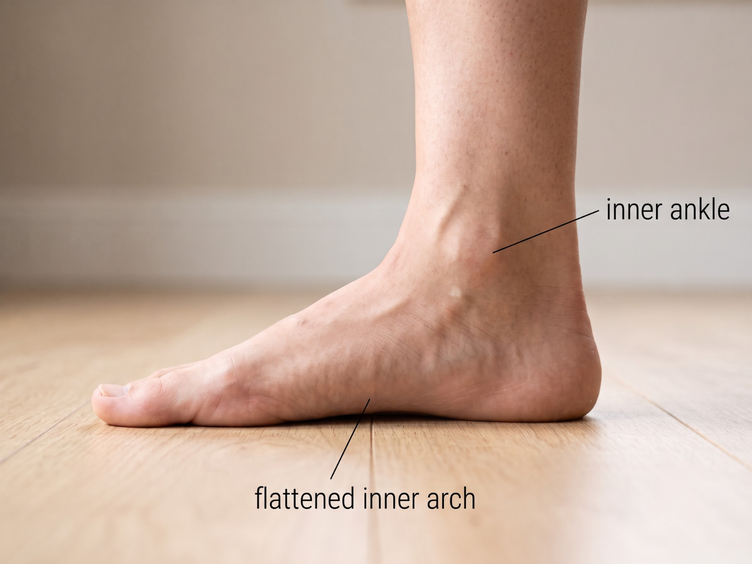
Flat Feet and Foot Arch Pain
Flat feet, also called fallen arches or pes planus,
describe a foot whose arch sits low or flattens under body weight. Many
people have flat feet without any symptoms at all. When pain does develop,
it is felt along the arch or the inner side of the foot and ankle, and
builds up over a day of standing or walking.
Foot arch pain is also common in people whose arches are normal but whose
supporting muscles have not kept pace with their activity.

Metatarsalgia and Morton's Neuroma
Metatarsalgia is pain across the ball of the foot caused by repeated
pressure through the long bones behind the toes. Morton's neuroma
is a related condition in which a nerve between the toes thickens and
becomes irritated, producing burning pain, numbness, or the sensation of
standing on a pebble.
Narrow shoes, high heels, and high-impact activity aggravate both.
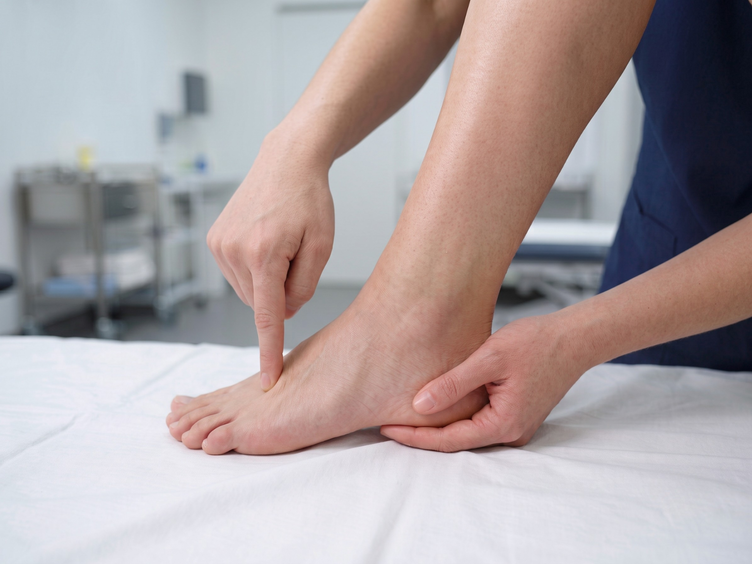
Ankle Sprains and Residual Instability
An ankle
sprain is a stretch or tear of the ligaments on the outer ankle,
usually caused by the foot rolling inwards. Pain and swelling often settle
within a few weeks, but a significant proportion of people are left with an ankle that feels
unstable, sprains repeatedly, or continues to ache through the foot
months later.
This lingering instability, rather than the original ligament damage, is
what drives most repeat
sprains.
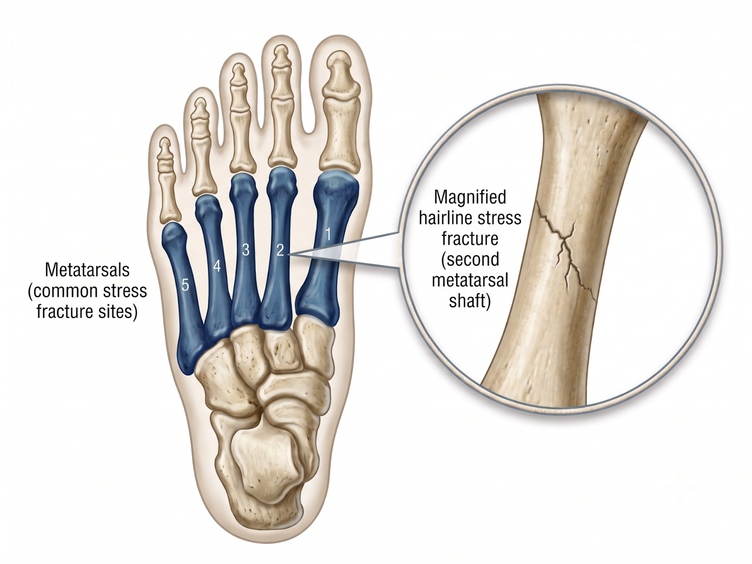
Stress Fractures and Bone Overload Injuries
A stress fracture
is a hairline crack in a bone caused by repetitive impact rather than a
single injury, most often in the metatarsals or the heel bone. It produces a
pinpoint tender spot that worsens the longer you stay on your feet. Runners,
dancers, and military recruits who have increased their training quickly
account for most cases.
A suspected stress fracture needs imaging to confirm, as the bone requires a
period of reduced loading before rehabilitation can begin.
Foot Pain and Related Symptoms
The location and timing of your foot pain often point towards its cause, so the pattern matters as much as the pain itself. Common symptoms include:
- Pain under the heel that is sharpest on your first steps of the day
- Pain at the back of the heel or just above it
- Aching through the arch or inner foot that builds over hours of standing or walking
- Pain across the ball of the foot, worse in narrow or tight shoes
- Swelling, stiffness, or restricted movement at the ankle and toes
Other symptoms to look out for include:
- Burning, tingling, or numbness in the toes
- A sense that the ankle may give way, or a history of repeated sprains
- A single tender point over one bone that worsens the longer you stand
- Pain that settles with rest and returns as soon as you resume activity
- A change in your walking pattern, such as limping or shifting weight to the other foot
- Calluses or uneven wear patterns on your shoes
Generally, symptoms that develop gradually over weeks point to tissue or bone being overloaded, while pain that starts at the moment of a fall, twist, or impact more often points to an acute injury.
 Dealing with persistent foot pain? Book a
consultation with our physiotherapist for an assessment and a treatment plan matched to
your condition and your goals, so you can get back on your feet comfortably.
Dealing with persistent foot pain? Book a
consultation with our physiotherapist for an assessment and a treatment plan matched to
your condition and your goals, so you can get back on your feet comfortably.
Physiotherapy Treatment Options for Foot Pain
Physiotherapy for foot pain typically involves a combination of approaches, depending on your diagnosis, symptoms, and recovery goals.
Exercise Therapy and Strengthening
Exercise therapy is a programme of strengthening, mobility, and balance
exercises for the foot, calf, and hip, built up gradually to raise how much
load the foot can handle without pain. Stronger muscles supporting the arch and ankle mean
less force reaches the painful tissue.
Most foot conditions are managed this way, starting at a level the foot tolerates and
progressing as it allows.

Activity Guidance and Pacing
Activity pacing means matching your daily activity to what your foot can currently
tolerate. Walking distances, standing hours, training volume, and the specific
activities that aggravate your symptoms are reviewed together to set a sustainable level.
Foot pain often improves once the load drops far enough for the tissue to recover, and this rarely
requires stopping activity altogether.
Gait and Movement Retraining
Gait retraining adjusts how your foot contacts the ground when you walk or run.
Your step length, cadence (how many steps you take per minute), and which part of the foot lands
first are assessed, then adjusted in small increments.
Because you take thousands of steps a day, a small change to a repeated movement reduces the
cumulative stress on the painful area considerably.
Manual Therapy
Manual therapy is hands-on treatment applied to the foot, ankle, and calf, including joint
mobilisation (guided movement of a stiff joint) and soft tissue release
(sustained pressure on tight muscle). Its purpose is to reduce stiffness and
sensitivity enough for you to move and exercise comfortably.
The relief is short-term on its own, so it is paired with the exercise programme that produces
lasting change.
Taping, Orthotics and Footwear Advice
Taping, insoles, and footwear changes all reduce load on the painful structure while it
recovers. Taping supports the arch in the short term, insoles spread pressure over a
wider area, and switching to a more suitable shoe can make a noticeable difference on its own.
These are supportive measures rather than treatments in themselves, used to make the foot
comfortable enough for you to progress the strengthening work.
Shockwave Therapy
Shockwave therapy passes acoustic pressure waves through the affected tissue, which is thought to increase blood flow and stimulate tissue repair. It is used for conditions such as plantar fasciitis and Achilles tendinopathy that have persisted for several months and have not responded to exercise alone.
Dry Needling
Dry needling is a technique that uses fine needles to ease trigger points, which are tight, tender bands within a muscle. For foot pain the target is usually the calf, because calf tightness increases the pull on the heel and the sole beneath it. Dry needling is used as part of a broader treatment plan rather than on its own, usually alongside stretching and strengthening for the calf.
Some underlying causes of foot pain do not respond to rehabilitation alone. In those cases, our orthopaedic foot specialist can review your condition and advise on further treatment, such as image-guided injections or surgery. Rehabilitation continues alongside both.
Physiotherapist or Podiatrist for Foot Pain?
Physiotherapists and podiatrists both treat foot pain, but they approach the foot differently.
Physiotherapy focuses on movement and strength, using exercise programmes, manual therapy, gait
retraining, and shockwave therapy. Podiatry focuses on the structure of the foot along with skin
and nail health, using custom-made orthoses, footwear prescription, and treatment of the skin and
nails.
If your foot pain relates to activity, tendon overload, or injury, a physiotherapist is a suitable
starting point, because the assessment covers the ankle, calf, and hip alongside the foot. Pain
driven by the structure of the foot, or any problem involving the skin or nails, is better managed
by a podiatrist.
Where a fracture or tendon tear is suspected, or symptoms are not improving, an assessment by an
orthopaedic specialist is the next step.
When to Seek Medical Care for Foot Pain
It is advisable to see a physiotherapist or doctor if your foot pain has lasted more than two
weeks, returns each time you resume activity, or has begun to affect how you walk, work, or
sleep.
Some symptoms need medical assessment sooner, and the following warrant seeing a doctor on the
same day:
- Foot pain after a fall, twist, or direct impact, or an inability to put weight on the foot
- Sudden severe pain with visible deformity of the foot or ankle
- A sudden sharp pain at the back of the heel, often described as feeling struck or kicked from behind
- Fever, redness, warmth, or spreading swelling, which can indicate infection
- Numbness, tingling, or weakness in the foot, particularly if you have diabetes
- A wound or ulcer on the foot that is not healing
- Pain that is constant, present at rest, or worse at night
Foot pain is typically easier to treat before it changes how you walk. Once a limp develops, recovery can take longer, and the opposite leg may begin to develop symptoms too.
Cost of Physiotherapy Services for Foot Pain
At Apex Sports Clinic, we provide physiotherapy alongside orthopaedic services, so imaging, specialist review, and any further treatment can be arranged on site. Our fees are as follows:
| Treatment & Service | Estimated Cost (SGD)^* |
|---|---|
| Consultation & Assessment | |
| Physiotherapy | $212.55 per 45-minute session |
| Physiotherapy (Home Visit) | $272.50 per 45-minute session |
| Diagnostic Services | |
| X-Ray | From $100 |
| MRI Scan | From $1,000 |
| Ultrasound Imaging | From $100 |
| Gait Analysis | From $200 per session |
| Non-Invasive Treatments | |
| Sports Massage / Conditioning | From $160 per session |
| Shockwave Therapy | From $100 per session |
| Bracing / Casting / Splinting | From $300 |
| Injection-Based Treatments | |
| Corticosteroid Injection | From $250 per injection |
| Platelet-Rich Plasma (PRP) Treatment | From $1,000 per injection |
| Ultrasound Guidance for Injections (in addition to cost of injection) | From $150 |
^Last updated: 2026-08-11
*Prices listed above are estimates and may vary depending on the complexity of the condition,
type of procedure, and other clinical considerations.
For treatments or services not listed above, please contact us to enquire further.
Foot pain is usually a problem of how the foot is used rather than structural damage, which is why physiotherapy targets the cause and not only the painful area. Strengthening and gait retraining can restore comfortable walking for most patients.
Dr Foo Gen Lin
Book a Physiotherapy Consultation for Foot Pain
Apex Novena
Why Do Patients Choose Apex Sports Clinic?
Sports Doctor in Singapore: Personalised & Affordable Care
One-Stop Sports Clinic
We provide comprehensive care in one clinic, from consultation, imaging, and injections through to physiotherapy, sports massage, and surgery when needed.
Keyhole Surgery Expertise
We specialise in arthroscopic keyhole surgery to treat sports injuries with precision and minimal tissue disruption, supporting faster recovery and restored joint function.
Specialist in Sports Injury Management
We combine evidence-based injury management with a proactive approach to maintaining your body's strength and function, so you can recover fully and perform at your peak.
Patient Journey
1 . Schedule Your Appointment

2 . Expert Diagnosis & Consultation

3 . Customised Treatment Plan

Schedule an Appointment

Our Insurance Partners




Frequently Asked Questions (FAQs)
Physiotherapy can often help relieve foot pain by reducing the strain on the painful tissue, building strength through the foot, calf, and hip, and adjusting how you walk or run. It is commonly used for conditions such as plantar fasciitis, Achilles tendinopathy, and ankle sprains. If your foot pain has lasted more than a couple of weeks, it may be worth having it assessed before it changes how you walk.
Seeing a physiotherapist is generally recommended for foot pain that has lasted beyond two weeks, keeps returning when you resume activity, or has begun to affect how you walk, work, or sleep. Short-lived soreness after unusual activity often settles on its own. Pain that starts after a fall or twist, particularly if you cannot stand on the foot, can point to a more serious injury and needs medical attention first.
The cost of physiotherapy in Singapore varies with clinic, session length, and whether treatments such as shockwave therapy are included. Subsidised rates are available at public hospitals and polyclinics, usually with a referral. At Apex Sports Clinic, physiotherapy is $212.55 for a 45-minute session and $272.50 for a home visit.
Neither is better overall, as physiotherapists and podiatrists approach the foot differently. Physiotherapy focuses on movement, strength, and rehabilitation, which suits pain related to activity, tendon overload, or injury. Podiatry focuses on the structure of the foot along with skin and nail health, which suits problems needing custom-made orthoses or nail and skin treatment. For most activity-related foot pain, a physiotherapist is the more common starting point.
No single therapy suits all foot pain, as treatment depends on the cause. Exercise-based rehabilitation is the most widely used approach for tendon and overload-related problems, often combined with activity pacing, footwear changes, and manual therapy. Shockwave therapy is sometimes added for plantar fasciitis or Achilles tendinopathy that has persisted for several months. Identifying the cause first is what determines which of these is likely to suit you.
A physiotherapist can identify signs that suggest inflammation, such as swelling, warmth, tenderness, and pain present at rest, though a physical examination alone cannot confirm it. Imaging or blood tests are used where inflammation is suspected, particularly if infection or inflammatory arthritis is possible. Many long-standing foot conditions, including Achilles tendinopathy, involve gradual tissue changes rather than active inflammation.
There is no instant cure for foot pain, though symptoms often settle sooner when the activities aggravating them are eased early rather than pushed through. Supportive footwear and over-the-counter pain relief may help in the short term, while strengthening and changes to how you walk help address why the pain developed. If pain persists beyond two weeks, it may be worth seeing a physiotherapist to clarify what is causing it.
Whether walking helps depends on what is causing your foot pain and how easily it flares up. Gentle walking within a comfortable distance is often encouraged for overload-related conditions, as complete rest tends to slow recovery. If pain builds as you walk, a limp develops, or a stress fracture is suspected, cut down your standing and walking and see a physiotherapist or doctor before continuing.
Massage of the calf and sole may ease tightness and offer short-term relief, though it does not address why the pain developed. Avoid it over a recent injury, an area that is hot or swollen, an open wound, or a foot with reduced sensation from diabetes. Pressing too hard can aggravate the area, so it is worth checking with a physiotherapist how massage should be applied for your foot pain.
Physiotherapy in Singapore is usually charged per session rather than by the hour, with most private sessions running 45 to 60 minutes. Cost varies with the clinic, the therapist's experience, and whether treatments such as shockwave therapy are included. At Apex Sports Clinic, a 45-minute session is $212.55, and a 45-minute home visit is $272.50.
Occupational therapy (OT) and physiotherapy address different goals, so neither is better overall. Physiotherapy works on movement, strength, and rehabilitation of the affected area. OT focuses on carrying out daily tasks at home or work, often using aids or adapted techniques. For foot pain, physiotherapy is the more usual starting point, while OT becomes relevant when an injury limits everyday activities more broadly.
Physiotherapy in Singapore is subsidised at public hospitals and polyclinics for eligible patients, usually following a doctor's referral. Private clinic sessions are not subsidised, though many company health plans and insurance policies cover part of the cost. MediSave generally cannot be used for outpatient physiotherapy. Checking with your insurer or the clinic beforehand gives a clearer idea of what you will pay.
No single type of doctor suits every case of foot pain. A general practitioner (GP) is a reasonable first point of contact for pain that is mild or recent. Activity-related, persistent, or injury-related foot pain is commonly seen by a sports doctor, while an orthopaedic foot specialist manages fractures, tendon tears, and problems that may need injections or surgery.
Foot symptoms worth looking out for include pain lasting more than two weeks, pain that returns each time you resume activity, numbness or tingling in the toes, an ankle that repeatedly gives way, and a change in how you walk. A wound that is not healing needs prompt review, particularly if you have diabetes. If symptoms persist, consider seeing a physiotherapist or doctor to clarify the cause.
Physiotherapists assess foot pain directly, and no doctor's referral is required to see one at a private clinic in Singapore. The assessment covers your symptoms, footwear, and activity, followed by a physical examination of the foot and ankle, with the calf and hip typically checked as well. Where a fracture, tendon tear, or other structural problem is suspected, imaging or a specialist review may be needed.