
Golfer's Elbow (Medial Epicondylitis)
Information reviewed by: Dr Foo Gen Lin | Last updated:
Golf, gym, or daily tasks aggravating the inside of your elbow? Dr Foo provides a thorough assessment and a structured treatment plan to ease golfer's elbow and protect long-term tendon health.

MBBS (University of London) | MMed (Ortho) | FRCSEd (Ortho) | FAMS (Ortho)

What Is Golfer's Elbow?
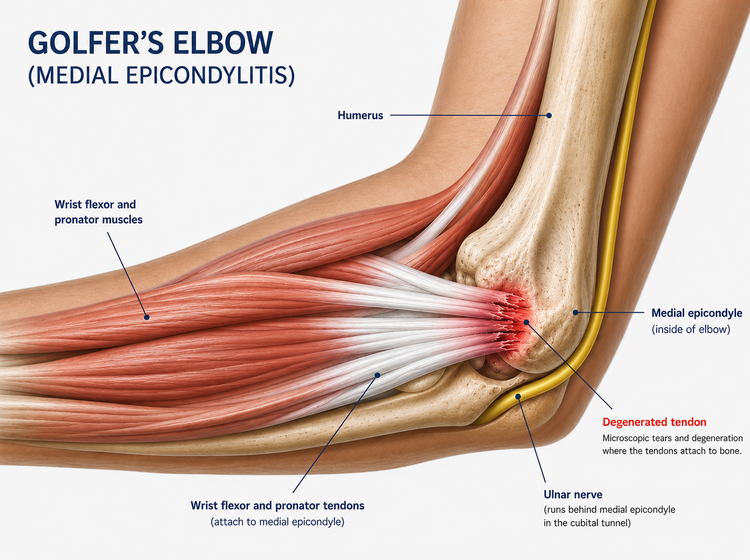
Golfer's elbow is a condition that causes pain on the inside of the elbow,
where the forearm muscles attach to a bony bump called the medial epicondyle. Its medical
name is medial epicondylitis,
although the condition is now better understood as a tendinopathy, a process of tendon
degeneration and microscopic tearing rather than true inflammation.
Although the condition is named after golf, it can affect anyone whose forearm tendons take
on repetitive load. Tennis players develop it from serves and forehand topspin rather than
the backhand, and baseball pitchers, weightlifters, manual workers, and office staff who
grip tools or type heavily are all commonly affected.
Golfer's elbow is considerably less common than tennis elbow, but the underlying mechanism
of tendon overload is similar.
What Causes Golfer's Elbow?
Golfer's elbow is caused by repeated stress on the wrist flexor and pronator
tendons, the muscles responsible for bending the wrist and rotating the forearm. This
repeated loading leads to microscopic tears and degeneration at their attachment on the inside of
the elbow.
Common contributors include:
- Sports involving repetitive arm motion – Golf, tennis, baseball and other throwing sports, and weightlifting can all overload the forearm flexors, especially with poor technique or unsuitable equipment.
- Occupational tasks – Jobs that involve frequent gripping, hammering, carpentry, plumbing, kitchen work, assembly line tasks, or using power tools can strain the inner elbow tendons. Prolonged keyboard and mouse use with poor ergonomics may also contribute.
- Sudden increase in activity – Ramping up training, lifting heavier loads, or returning to sport without conditioning can overwhelm the tendons before they have time to adapt.
- Age-related tendon changes – Tendons become less elastic and slower to recover with age, making adults aged 40 and above more susceptible.
- Underlying conditions – Diabetes, smoking, and obesity have been associated with a higher likelihood of tendinopathy, including golfer's elbow. Smoking is known to impair tendon blood supply and healing.
The condition usually develops over weeks to months, although a single forceful movement can trigger symptoms in someone with an already weakened tendon.
Golfer's Elbow Symptoms
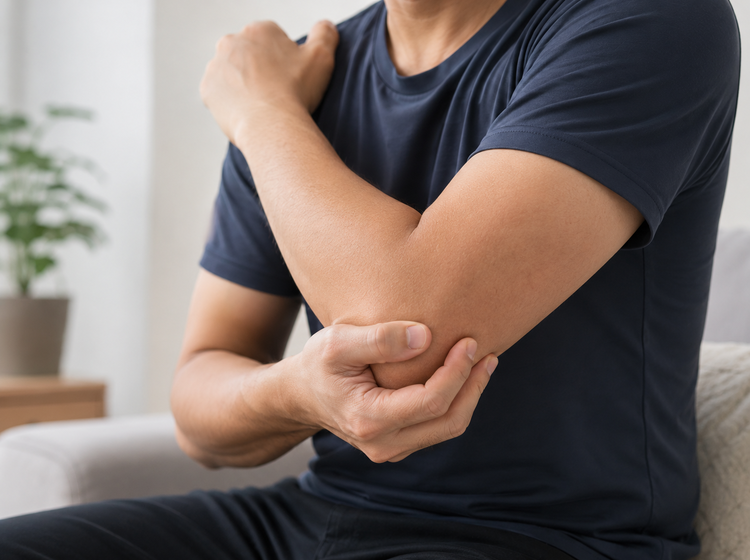
The main symptom of golfer's elbow is pain and tenderness on the inside of the
elbow, which can radiate down the forearm towards the wrist.
Symptoms usually develop gradually over weeks to months, although a single forceful movement can
occasionally trigger them in someone with an already weakened tendon.
Common signs include:
- Pain on the inner side of the elbow, particularly over the medial epicondyle (the bony bump on the inside of the elbow)
- Tenderness when pressing on the medial epicondyle
- Pain that worsens with gripping, lifting, or rotating the forearm (such as turning a screwdriver or pouring from a kettle)
- Weakness in the hand and wrist that makes it harder to shake hands, turn a doorknob, or hold a cup
- Stiffness in the elbow, especially after rest
- Numbness or tingling in the ring and little fingers, which may indicate associated ulnar nerve irritation
Without appropriate treatment, symptoms can become chronic and progressively limit normal hand and wrist function.
 Experiencing persistent pain on the inside of your
elbow? Don't wait for it to worsen. Schedule a
consultation with our elbow
specialist for a thorough assessment and personalised treatment.
Experiencing persistent pain on the inside of your
elbow? Don't wait for it to worsen. Schedule a
consultation with our elbow
specialist for a thorough assessment and personalised treatment.
Golfer's Elbow vs Tennis Elbow: What's the Difference?
Golfer's elbow and tennis elbow are both forms of elbow tendinopathy caused by overuse, but they affect opposite sides of the elbow and involve different muscle groups.
| Feature | Golfer's Elbow (Medial Epicondylitis) | Tennis Elbow (Lateral Epicondylitis) |
|---|---|---|
| Location of pain | Inside of the elbow | Outside of the elbow |
| Tendons affected | Wrist flexors and pronators (muscles that bend the wrist and rotate the forearm) | Wrist extensors (muscles that straighten the wrist) |
| Aggravating movements | Gripping, bending the wrist down, rotating the forearm | Bending the wrist back, backhand strokes, lifting with the palm down (such as carrying a tray) |
| Common activities | Golf swing, throwing, weightlifting, manual labour | Tennis, painting, carpentry, plumbing |
| Pain on examination | Worsens when bending the wrist down against resistance | Worsens when bending the wrist back against resistance |
| How common | Less common | More common (affects roughly 1–3% of the population) |
Although the two conditions differ in location and triggering movements, they share similar
underlying causes, and the treatment principles, including rest, physiotherapy, and progressive
tendon loading, are broadly similar.
In some cases, particularly in people whose jobs involve repetitive gripping or heavy tool use, both
conditions can occur together.
How Is Golfer's Elbow Diagnosed?
Golfer's elbow is diagnosed mainly through a clinical examination of the elbow and forearm, with imaging reserved for cases that need further assessment. The evaluation usually involves:
Medical History Review
Review of your symptoms, when they began, the activities that aggravate them, and any overuse, injury, or related medical conditions.
Physical Examination
Checking for tenderness over the medial epicondyle, assessing forearm and wrist strength, and observing range of motion in the elbow and wrist.
Golfer's Elbow Test (Resisted Wrist Flexion Test)
With your arm straight, you bend your wrist downward against resistance. Pain reproduced at the inner elbow is a positive sign of medial epicondylitis.
Imaging Tests
X-rays may be used to rule out other causes of inner elbow pain such as arthritis, bone spurs, calcifications within the tendon, or previous fractures. Ultrasound or MRI can confirm tendon damage, identify partial or complete tears, and detect coexisting nerve compression when the diagnosis is unclear.
Nerve Conduction Studies
Tests that measure how quickly and effectively electrical signals travel along a nerve. These may be recommended if there is numbness, tingling, or weakness suggesting ulnar nerve involvement.
Imaging is not always required for early or mild cases. It becomes more useful when symptoms are severe, do not improve with treatment, or suggest a tendon tear or ulnar nerve involvement.
Golfer's Elbow Treatment
Treatment for golfer's elbow ranges from non-surgical to surgical options, depending on the severity of symptoms, the extent of tendon injury, and the duration of the condition. Most cases improve with non-surgical treatment, while persistent or more severe cases may require surgery.
1. Non-Surgical Treatment
Rest and Activity Modification
Reducing repetitive gripping, wrist flexion, and forearm rotation gives the affected tendon time to recover. Adjusting sports technique, equipment, or workload may also help reduce strain and prevent recurrence.
Bracing or Strapping
A counterforce brace or forearm strap can reduce stress on the tendon during activity and help relieve pain. In some cases, a wrist splint may be worn at night to allow the forearm muscles to rest.
Ice and Anti-Inflammatory Medication
Cold packs and oral non-steroidal anti-inflammatory drugs (NSAIDs) may help reduce pain and inflammation, particularly during the early stages of symptoms.
Physiotherapy
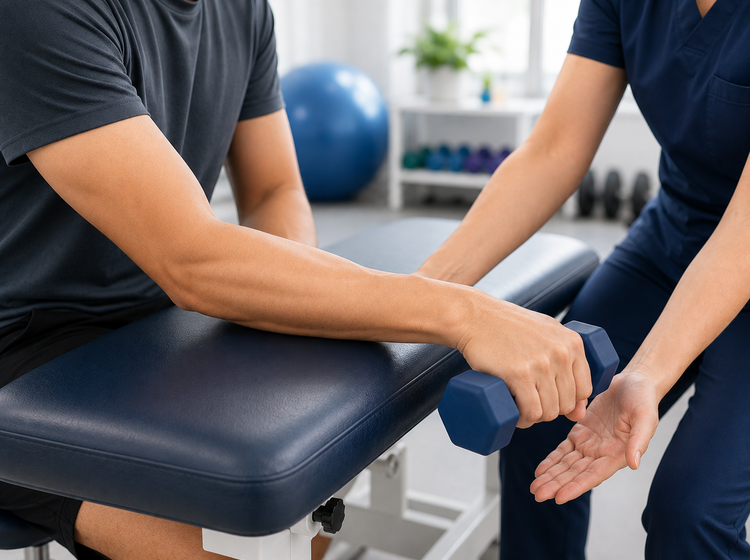
Physiotherapy usually includes stretching, progressive strengthening exercises, and eccentric wrist flexor training to improve tendon capacity and support recovery. Manual therapy and movement correction may also be incorporated where needed.
Injection-Based Treatment
Corticosteroid injections may
provide short-term pain relief in more severe cases, although repeated injections are generally
avoided due to potential tendon weakening. Platelet-rich plasma (PRP)
injections may be considered in chronic cases to support tendon healing.
Other regenerative injection therapies, such as hyaluronic acid injections,
may occasionally be used in selected chronic cases, although evidence for their effectiveness is
still evolving.
Shockwave Therapy
Extracorporeal shockwave therapy (ESWT) uses sound-wave pulses to stimulate tendon repair and reduce pain. It is commonly used for tendinopathies that do not improve sufficiently with physiotherapy alone.
2. Surgical Treatment
Arthroscopic Release
Arthroscopic release for golfer's elbow reduces pain and removes diseased tendon tissue through a minimally invasive keyhole procedure using small incisions around the elbow. Less disruption to surrounding soft tissue may support faster recovery and earlier rehabilitation in selected cases.
Tendon Debridement and Repair
Open tendon debridement and repair removes damaged tendon tissue and repairs the remaining healthy tendon through a larger incision over the medial epicondyle. This procedure is generally considered for more severe or persistent cases that do not improve after months of non-surgical treatment.
Golfer's Elbow Recovery Time and Healing
Recovery from golfer's elbow varies widely, but most cases improve over weeks to months with
appropriate treatment. Mild cases caught early may settle within a few weeks of rest
and physiotherapy, while chronic or severe cases can take longer.
A small number of patients develop persistent symptoms that last beyond a year and may benefit from
more advanced treatment.
Factors that influence recovery include:
- How long symptoms were present before treatment began
- The severity of tendon damage on examination or imaging
- How closely you follow the physiotherapy programme and avoid aggravating activities
- Underlying conditions such as diabetes or rheumatoid arthritis
- The type of treatment received, including injection or surgery
Returning to sport or heavy gripping too early is one of the most common reasons for recurrence. A
gradual return, guided by a physiotherapist or sports doctor, helps protect the healing tendon.
For patients who undergo surgery, light daily activities can usually be resumed within a few weeks,
but full recovery and return to sport may take several months.
How to Prevent Golfer's Elbow
Golfer's elbow can often be prevented by reducing repetitive strain on the forearm tendons and keeping the wrist, hand, and forearm well conditioned. Practical measures include:
- Strengthen the forearm and grip – Regular strengthening exercises build tendon resilience and tolerance to load. Eccentric exercises, which work the muscle as it lengthens under load, are particularly effective for tendon conditioning.
- Use proper technique – In sports such as golf and tennis, correcting your grip, swing, or follow-through reduces unnecessary load on the inner tendons. Professional coaching can help you spot and fix technique problems that put strain on the tendons.
- Increase activity gradually – Build up training volume or workload progressively so that tendons have time to adapt.
- Adjust your equipment – Lighter clubs, racquets with the right grip size, padded handles, and ergonomic tools all reduce stress on the inner elbow.
- Warm up and stretch – Gentle forearm stretches and a graded warm-up improve tendon flexibility and prepare the muscles for activity.
- Take breaks during repetitive tasks – Brief pauses during typing, lifting, or tool use help reduce the build-up of strain on the tendons.

When to See a Doctor for Golfer's Elbow
You should consult a doctor or elbow specialist if you experience:
- Inner elbow pain that lasts more than a few weeks despite rest
- Pain that interferes with daily activities, work, or sport
- Weakness in the hand or grip that makes it difficult to carry, lift, or hold objects
- Numbness or tingling in the ring and little fingers
- Sudden severe pain following a forceful movement or injury, which may need urgent assessment
- Visible swelling, bruising, or deformity around the elbow
- Locking or catching of the elbow during movement (a sensation of the joint getting stuck or snagging)
- Symptoms that recur after initial improvement
With early assessment and a tailored treatment plan, most patients with golfer's elbow return to sport and daily activities without needing surgery. The key is recognising the symptoms early and addressing them before the damage becomes long-term.
With early assessment and a tailored treatment plan, most patients with golfer's elbow return to sport and daily activities without needing surgery. The key is recognising the symptoms early and addressing them before the damage becomes long-term.
Dr Foo Gen Lin
Find a Shoulder and Elbow Specialist in Singapore
Apex Novena
Why Do Patients Choose Apex Sports Clinic?
Sports Doctor in Singapore: Personalised & Affordable Care
One-Stop Sports Clinic
We provide comprehensive care in one clinic, from consultation, imaging, and injections through to physiotherapy, sports massage, and surgery when needed.
Keyhole Surgery Expertise
We specialise in arthroscopic keyhole surgery to treat sports injuries with precision and minimal tissue disruption, supporting faster recovery and restored joint function.
Specialist in Sports Injury Management
We combine evidence-based injury management with a proactive approach to maintaining your body's strength and function, so you can recover fully and perform at your peak.
Patient Journey
1 . Schedule Your Appointment

2 . Expert Diagnosis & Consultation

3 . Customised Treatment Plan

Schedule an Appointment

Our Insurance Partners




Frequently Asked Questions (FAQs)
While recovery varies, golfer's elbow often improves faster when relative rest is combined with active rehabilitation rather than rest alone. Stopping the aggravating gripping or wrist activity, applying ice early on, and taking non-steroidal anti-inflammatory drugs (NSAIDs) if appropriate can ease the early pain. If pain persists or you want a more structured approach to recovery, seeing a sports doctor for an assessment can help guide the next steps.
Mild cases of golfer's elbow can settle on their own with rest, activity modification, and avoidance of aggravating movements. Moderate or severe cases often persist or worsen without targeted rehabilitation, as the tendon may continue to degenerate under load. Symptoms that linger for several weeks, recur with normal activity, or interfere with daily tasks usually warrant a closer look. Considering an assessment from a sports doctor can help clarify the cause and discuss treatment options.
Recovery from golfer's elbow varies from person to person, but improvement usually occurs over several weeks to a few months with appropriate treatment. Milder cases caught early may settle within a month or two, while moderate cases can take several months, and chronic or surgically treated cases may need closer to a year. Severity of tendon damage, adherence to rehabilitation, age, and conditions such as diabetes can all lengthen the timeline. It is best to consult a sports doctor who can review your situation and give a clearer sense of what to expect.
Golfer's elbow falls under elbow tendinopathy, the modern umbrella term for tendon overuse conditions. The older label “tendonitis” implies active inflammation, but research now shows golfer's elbow involves tendon degeneration and microscopic tearing with limited inflammatory cells, making “tendinopathy” or “tendinosis” more accurate. Both labels are commonly used interchangeably in everyday language, but the underlying mechanism is degenerative rather than purely inflammatory.
Golfer's elbow itself causes pain at the inner elbow, the bony bump on the inside of the elbow felt when the arm hangs by your side, but numbness or tingling can occur when the nearby ulnar nerve is irritated, as it runs close to the medial epicondyle. The ulnar nerve supplies sensation to the ring and little fingers, so symptoms there may suggest coexisting cubital tunnel syndrome rather than the tendinopathy alone. If you notice numbness, tingling, or hand weakness alongside elbow pain, it may be worth seeing a sports doctor for an assessment.
Golfer's elbow can be confused with several conditions that cause inner elbow or forearm symptoms. Conditions that can present similarly include cubital tunnel syndrome (ulnar nerve compression), pronator teres syndrome, medial collateral ligament injury, cervical radiculopathy from a pinched neck nerve, and elbow arthritis. The location and quality of pain, presence of numbness or weakness, and triggering activities help distinguish them.
Playing through golfer's elbow tends to worsen tendon damage and prolong recovery, so a temporary break is usually advised. Once pain settles and rehabilitation is underway, a graded return with attention to technique, grip size, and equipment can help prevent recurrence. Coaching, warm-up routines, and forearm conditioning are useful at this stage. Before resuming play, an assessment from an elbow specialist or sports doctor can help gauge whether the tendon is ready for load.
Golfer's elbow rarely requires surgery, as most cases respond to non-surgical treatment within several months. Surgery is generally considered when symptoms persist for many months despite physiotherapy, bracing, and injections, or when imaging shows significant tendon tears. The procedure involves removing degenerated tendon tissue and repairing the healthy portion, either openly or arthroscopically.
Untreated golfer's elbow often progresses from a mild ache during activity to persistent pain that interferes with daily tasks like lifting, gripping, or shaking hands. The tendon may degenerate further, develop partial tears, or lead to chronic weakness that takes longer to recover. Ulnar nerve irritation can also develop alongside long-standing tendinopathy. If you have been experiencing symptoms, an early assessment can help identify the cause and start appropriate treatment before symptoms become long-standing.
Ice tends to be more useful in the early or acute phase of golfer's elbow, when pain is sharp and the tendon feels irritated, as it can reduce discomfort and swelling. Heat is generally more helpful in the chronic phase to improve blood flow, ease stiffness, and prepare the forearm for stretching or exercise. Many people alternate the two depending on the stage. If symptoms persist or you are unsure how to manage them, a sports doctor can assess the tendon and recommend a treatment plan suited to your case.
Eccentric exercises are commonly used in golfer's elbow rehabilitation and are widely considered helpful for tendon recovery. They involve slowly lengthening the wrist flexor muscles under load, which improves tendon strength and resilience to stress. A common example is a wrist flexor curl lowered slowly with a light dumbbell, but these exercises should not be attempted on your own for golfer's elbow or any other elbow injury, as incorrect load or timing can worsen the tendon. A sports doctor or physiotherapist can assess your stage of recovery and prescribe a suitable programme.
Golfer's elbow can sometimes cause pain to spread along the inner forearm and occasionally towards the inner upper arm, but true shoulder pain is not a typical feature. Pain felt higher up may suggest a separate issue such as bicep tendinopathy, rotator cuff pathology, or referred pain from the neck. If discomfort extends well beyond the elbow, a clinical assessment can help identify whether more than one condition is contributing.
Golfer's elbow is usually addressed with a combination of relative rest, activity modification, ice, anti-inflammatory medication, and a structured physiotherapy programme focused on eccentric forearm strengthening. Counterforce bracing or strapping may help during return to activity. Persistent cases may benefit from corticosteroid or platelet-rich plasma (PRP) injections, shockwave therapy, or, in rare instances, surgery. If you are experiencing symptoms, it is best to seek a proper assessment and treatment.
The main cause of golfer's elbow is repeated overload of the wrist flexor and pronator tendons where they attach to the inner side of the elbow, the bony bump felt on the inside when the arm hangs by your side. This repeated loading leads to microscopic tears and tendon degeneration. It typically results from gripping, wrist flexion, or forearm rotation performed repetitively or with poor technique, in activities such as golf, tennis, throwing sports, weightlifting, or manual work. Age-related tendon changes, sudden increases in training, and conditions such as diabetes can raise the risk further.
Light massage around the forearm muscles can ease tightness, but firm pressure directly over the tender bony bump on the inner elbow may aggravate the irritated tendon, especially in the acute phase. Techniques like cross-friction massage or foam rolling can have a role, but they are best done under guidance rather than on your own, as wrong pressure or timing can worsen the tendon. If you are experiencing symptoms, it is best to seek a proper assessment so any hands-on treatment can be matched to your stage of recovery.
You should seek prompt assessment for golfer's elbow if you notice severe pain following a sudden forceful movement, visible swelling or deformity around the elbow, locking or catching of the joint, numbness or weakness in the hand or fingers, or symptoms that fail to improve after a few weeks of rest. Recurrent flare-ups or pain that disrupts sleep, work, or daily activities also warrant evaluation.
With golfer's elbow, avoid repeated gripping, heavy lifting, forceful wrist flexion, and forearm rotation movements that reproduce the pain, as continued loading delays healing. Pushing through sport, gym work, or manual tasks usually prolongs symptoms and can lead to tendon tears. Corticosteroid injections are generally advised not to be repeated frequently, as they may weaken the tendon. You should always seek and follow the advice of your doctor, specialist or physiotherapist for guidance specific to your situation.
Persistent golfer's elbow often reflects ongoing tendon overload, inadequate rehabilitation, or factors that impair tendon healing. Common reasons include returning to activity too soon, poor sport or work technique, skipping eccentric strengthening exercises, smoking, and conditions such as diabetes. Coexisting issues like ulnar nerve irritation or a missed tendon tear can also stall recovery. If symptoms persist beyond a few months, speak to your doctor, or arrange to see one if you have not already, to help identify what is delaying recovery and explore further options.
Whether you can continue lifting with golfer's elbow depends on the severity and stage of your injury. Heavy gripping, pulling, and wrist flexion movements typically aggravate the condition and may need to be paused, while lighter training and structured eccentric forearm exercises may have a role as part of a supervised rehabilitation plan. Training without professional guidance can prolong recovery or worsen the tendon, so it is best to consult a sports doctor or physiotherapist before training through it if you have not already.
Sleeping with golfer's elbow can be more comfortable when the affected arm is supported and the elbow is kept relatively straight, since prolonged bending can compress the inner tendon and ulnar nerve. A pillow under the arm, a soft elbow sleeve, or a night splint to limit flexion may help reduce morning stiffness and night pain. Try to avoid sleeping directly on the affected side. If sleep remains persistently disturbed despite these measures, it may be worth seeking a proper assessment.
There is no instant cure for golfer's elbow, but recovery is often faster when you combine early diagnosis, activity modification, and a structured rehabilitation programme. Eccentric forearm strengthening, ice, anti-inflammatory medication, and counterforce bracing are often included. For stubborn cases, shockwave therapy or platelet-rich plasma (PRP) injections may help support tendon healing. If you are experiencing symptoms, it is best to seek a proper assessment so the right combination of treatments can be matched to your case.
Golfer's elbow causes pain on the inner side of the elbow, focused over the medial epicondyle, the bony bump felt on the inside when the arm hangs by your side. The pain may also radiate down the inside of the forearm towards the wrist and can be reproduced by gripping, lifting, or bending the wrist downward against resistance. Pain on the outer side of the elbow usually points to tennis elbow instead.
Golfer's elbow is usually confirmed through a clinical examination, which includes checking for tenderness over the medial epicondyle (the bony bump on the inside of the elbow) and performing the resisted wrist flexion test. With your arm straight, bending the wrist downward against resistance should reproduce pain at the inner elbow if medial epicondylitis is present. Ultrasound or magnetic resonance imaging (MRI) may be used in unclear cases or to rule out tears.