
Acromioclavicular (AC) Joint: Injury, Grades and Treatment
Information reviewed by: Dr Foo Gen Lin | Last updated:
Shoulder too painful to lift or sleep on after a fall? Consult our shoulder specialist or physiotherapists for assessment and treatment to help you return to work and sport.

MBBS | MMed (Ortho) | FRCSEd (Ortho) | FAMS (Ortho)

What Is the Acromioclavicular (AC) Joint?
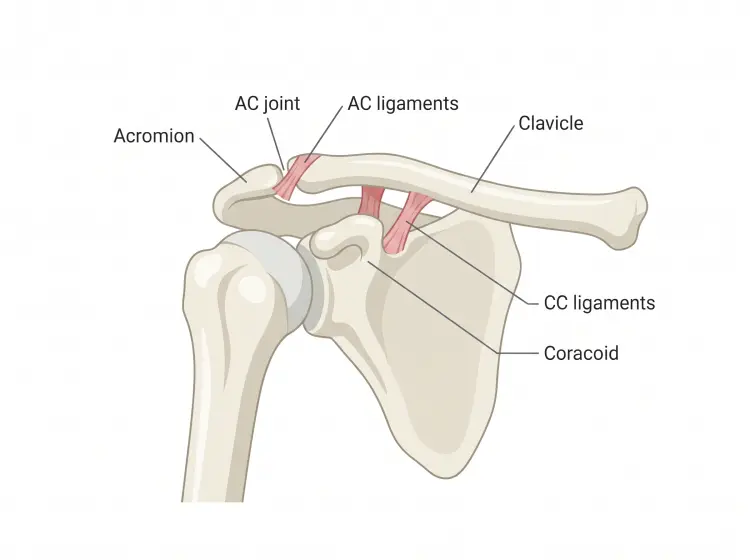
The acromioclavicular (AC) joint is the small joint at the top of the shoulder where the outer end of the collarbone (clavicle) meets the acromion, the highest point of the shoulder blade. The AC joint is sometimes shortened to ACJ.
This small joint is not the main shoulder joint, which is the ball-and-socket (glenohumeral) joint where the top of the upper arm bone sits in the shoulder socket.
The AC joint is a plane joint, in which two flat bone surfaces glide against each other. No muscle moves it directly, so it moves when the shoulder muscles move the shoulder blade.
The joint helps the shoulder move forwards and backwards and supports the shoulder as you use your arm. It is held together by the AC ligaments around it and the coracoclavicular ligaments below the collarbone.
What Are the Common AC Joint Problems?
The two common AC joint problems are an injury to the joint, such as a separation or dislocation, and arthritis, and both can cause AC joint pain. AC joint injuries are common shoulder injuries.
Separation or Dislocation
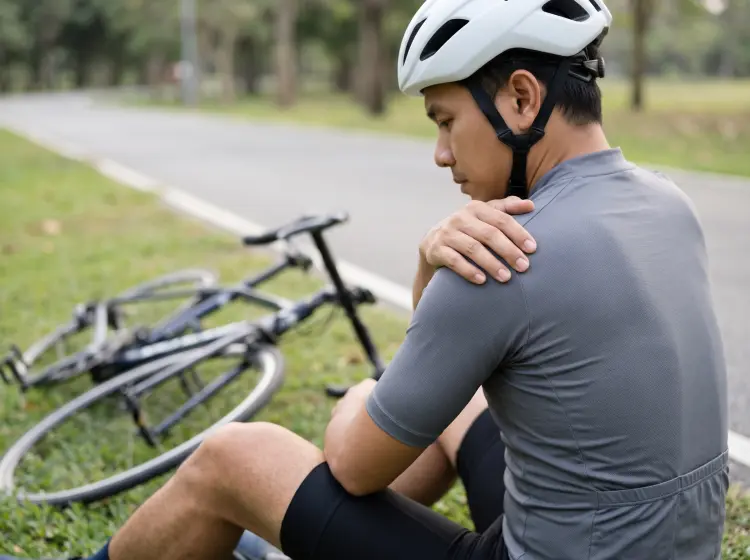
An AC joint separation, or dislocation, is an injury to the AC joint in which the ligaments that hold the collarbone to the shoulder blade are stretched or torn. It is usually caused by a fall or a direct blow onto the top of the shoulder with your arm at your side, which can force the shoulder blade down and away from the collarbone.
In more severe AC joint injuries, the outer end of the collarbone also moves out of line with the shoulder blade. An AC joint separation is also known as a dislocated AC joint or a separated shoulder, and it ranges from a mild sprain to a complete tear of the ligaments.
A separated shoulder is a ligament injury and usually does not involve a broken bone. It is also not the same as a dislocated shoulder, in which the top of the upper arm bone comes out of the shoulder socket.
The injury is common in contact sports such as rugby and among cyclists who fall onto the shoulder, and road accidents can cause it too. Less often, it can follow a fall onto the elbow.
Arthritis
AC joint arthritis is a type of shoulder arthritis in which the cartilage lining the joint wears away. It usually develops gradually with age, or after years of repeated overhead movements or heavy lifting, and it can also follow an earlier injury to the joint.
Many people with arthritis in the AC joint have no symptoms. In people who have symptoms, the pain is usually felt at the top of the shoulder and is often worse when you reach across your body.
What Are the Grades of an AC Joint Injury?
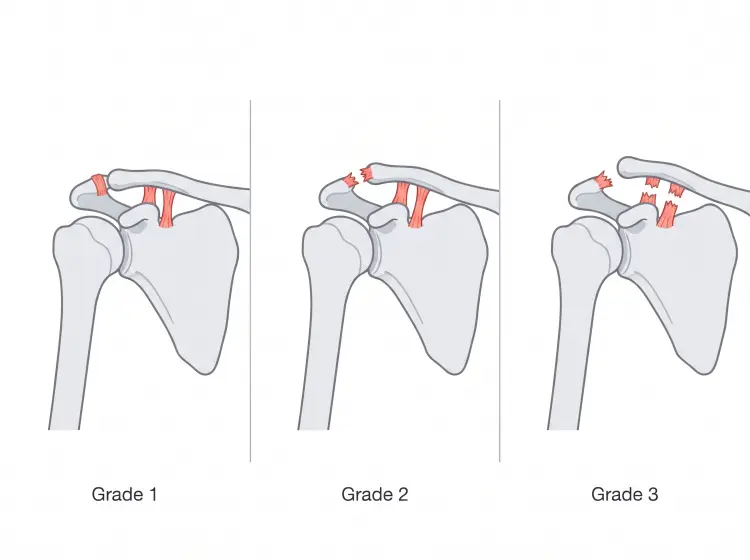
An AC joint injury is graded from 1 to 6 by which ligaments are stretched or torn, and how far and in which direction the end of the collarbone has moved.
The grades, also called types in the Rockwood classification, describe damage to two sets of ligaments: the AC ligaments around the joint itself, and the coracoclavicular (CC) ligaments, which hold the underside of the collarbone down to a hook-shaped part of the shoulder blade called the coracoid.
| Grade | What Happens to the Joint |
|---|---|
| Grade 1 | The AC ligaments are sprained and the collarbone stays in line, so there is no bump and an X-ray usually looks normal |
| Grade 2 | The AC ligaments are torn and the CC ligaments are sprained, so the end of the collarbone is slightly out of line (a subluxation) and may form a small bump |
| Grade 3 | The AC and CC ligaments are both torn, so the end of the collarbone is fully out of line and usually forms a larger bump |
| Grade 4 | The ligaments are torn and the end of the collarbone is pushed backwards |
| Grade 5 | The ligaments are torn and the end of the collarbone is pushed upwards, through the muscle above the joint |
| Grade 6 | A rare grade in which the ligaments are torn and the end of the collarbone is pushed downwards, under the coracoid |
What Are the Symptoms of an AC Joint Injury?
AC joint separation symptoms usually start straight after a fall or blow to the shoulder and include:
- Pain at the top of the shoulder – The pain is felt where the collarbone meets the shoulder blade. It is often worse when you lift the arm or reach across your body, as these movements press on the injured joint, so you may not be able to move the arm as far.
- Swelling and tenderness – The area over the AC joint can swell and feel sore to touch, as the injured ligaments and the tissue around them become inflamed.
- Bruising – Bruising can appear over the top of the shoulder from bleeding in the injured tissue.
- A bump at the top of the shoulder – A bump forms when the shoulder blade drops away from the collarbone under the weight of the arm, leaving the end of the collarbone raised. It is usually larger in more severe injuries, such as grade 3 and grade 5.
When to Seek Medical Attention
A fall or blow that leaves the top of the shoulder painful should generally be medically assessed, as treatment for an AC joint injury depends on its grade. Have the shoulder assessed promptly if you notice:
- A raised or uneven shoulder
- Difficulty moving the arm normally
- Pain that is not improving after a few days
Seek emergency medical care straight away if you have severe pain, or if your arm or fingers feel weak, numb or cold.
 Shoulder still sore or weak weeks after the injury? Book a consultation with our shoulder specialist for an assessment and a recovery plan that fits your work and sport.
How Is an AC Joint Injury Diagnosed?
An AC joint injury is usually diagnosed from how the injury happened, an examination of the shoulder and an X-ray, which can also show the grade.
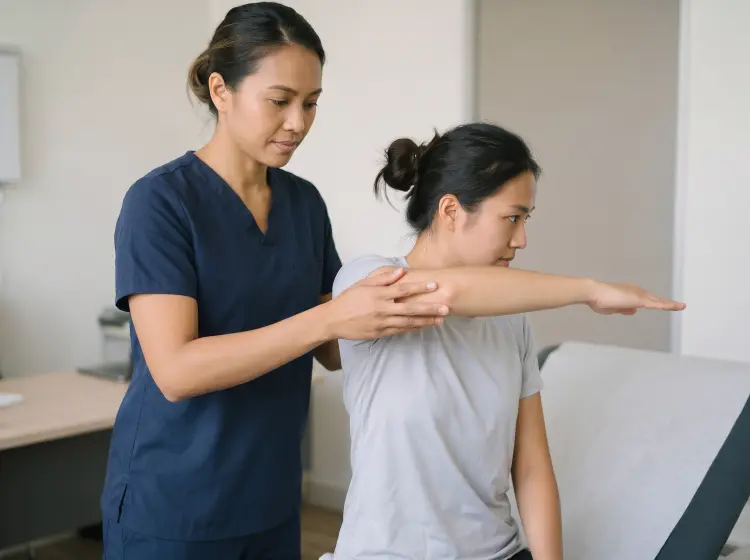
- Physical examination to check for tenderness and a bump over the AC joint, and for pain when the arm is lifted and brought across the chest. This movement, called the cross-body test, is a common test for a separated shoulder.
- X-ray to show how far the end of the collarbone has moved, and holding a light weight during the X-ray can make the gap between the collarbone and the shoulder blade easier to see. A mild AC joint separation may not show on an X-ray, so the diagnosis is then made from the examination.
- Ultrasound or magnetic resonance imaging (MRI) scan, sometimes arranged to show the ligaments in more detail or to check for other shoulder injuries.
How Is an AC Joint Injury Treated?
Treatment for an AC joint separation depends on the grade: most injuries are treated with a sling, ice, pain relief and physiotherapy, and only some need surgery.
Grades 1 and 2 are usually treated without surgery, and many grade 3 injuries are too, with surgery considered if the pain continues or the shoulder stays clearly out of shape. Grades 4, 5 and 6 usually need surgery.
Sling, Ice and Pain Relief
A sling supports the arm and can ease the pain, and it is usually worn for comfort for a few days to about 3 weeks. A special shoulder brace is rarely needed.
An ice pack wrapped in a damp towel, held on the shoulder for about 15 minutes every few hours, can reduce pain and swelling in the first few days. Paracetamol or an anti-inflammatory painkiller such as ibuprofen may be prescribed to ease the pain.
Physiotherapy
Physiotherapy for an AC joint injury aims to restore the shoulder's movement, strength and flexibility, and rehabilitation exercises are usually part of recovery whether or not surgery is performed.
AC joint exercises often start within the first few days, with gentle movements of the hand, elbow and shoulder blade to help prevent stiffness. Lifting the arm above shoulder height is usually avoided for about the first 3 weeks.
Strengthening exercises are added as the pain settles, followed by training for your sport or work.
Surgery
Surgery for an AC joint dislocation aims to hold the end of the collarbone back in line while the ligaments heal, or to rebuild the torn CC ligaments, which is called AC joint reconstruction.
It can be performed through small cuts with a camera (arthroscopy) or through a larger cut, and a sling and physiotherapy usually follow.
How Long Does an AC Joint Injury Take to Heal?
An AC joint injury usually takes from a few days to about 12 weeks to recover without surgery, and about 6 months when surgery is needed. The pain often starts to ease within a week of the injury. Typical AC joint injury recovery times are:
| Injury | Usual Recovery Time |
|---|---|
| Mild injuries (grades 1 and 2) | A few days to about 6 weeks |
| Other injuries treated without surgery | Up to about 12 weeks before a return to normal activities |
| Any grade treated with surgery | Limited use of the shoulder for about 6 weeks, then a return to normal activities after about 6 months |
Return to sport or manual work is usually possible once the pain has settled and shoulder movement is back to normal. After a more serious injury treated without surgery, contact sports such as rugby and heavy lifting are usually avoided for at least 6 weeks, sometimes longer.
Recovery times vary from person to person, so always follow the advice of your specialist, physiotherapist or surgeon.
A bump that has formed usually remains, even when the shoulder works well again. Some people have ongoing pain or a feeling that the joint is unstable, which should generally be medically assessed if it lasts more than about 3 months.
Most AC joint injuries can heal well without surgery. Rebuilding strength around the shoulder can then help you get back to work and to your sport with confidence.
Dr Foo Gen Lin
Find a Shoulder Specialist Near Me
Apex Novena
Why Do Patients Choose Apex Sports Clinic?
-
16+
-
30,000+
-
3,000+
Sports Doctor in Singapore: Personalised & Affordable Care
One-Stop Sports Clinic
Consultation, imaging and injections through to physiotherapy, sports massage and surgery, all in one clinic.
Keyhole Surgery Expertise
Arthroscopic keyhole surgery for sports injuries, using small incisions to limit tissue disruption, with open surgery available when an injury needs it.
Specialist in Sports Injury Management
Evidence-based injury care that also builds your strength and function, to support your recovery and return to sport.
Your Patient Journey at Apex Sports Clinic
-
 1
Schedule Your Appointment
Book online or WhatsApp us, and our team will get back to you as soon as we can.
-
 2
Consultation & Diagnosis
We assess your condition and explain what is causing your symptoms, in plain terms.
-
 3
Customised Treatment Plan
A plan matched to your condition, your goals and the activities you want to return to.
Schedule an Appointment

Our Insurance Partners




Frequently Asked Questions (FAQs)
The acromioclavicular (AC) joint is a plane joint, a type of synovial joint where two flat bone surfaces slide over each other. A synovial joint sits inside a capsule lined with a membrane that makes lubricating fluid. The AC joint sits at the top of the shoulder, where the collarbone meets the top of the shoulder blade. Unlike the main ball-and-socket shoulder joint, it is not moved directly by any muscle.
No, the acromioclavicular (AC) joint is not part of the rotator cuff, although both are in the shoulder. The AC joint is where the collarbone meets the acromion at the top of the shoulder, and ligaments hold it together. The rotator cuff is a group of muscles and tendons that keeps the top of the upper arm bone centred in the shoulder socket. Problems in either can cause shoulder pain, so an examination is often needed to tell them apart.
The deltoid and trapezius muscles help stabilise the acromioclavicular (AC) joint, working alongside the ligaments that hold the joint together. The deltoid covers the outside of the shoulder, while the trapezius runs from the neck and upper back to the collarbone and shoulder blade. After an AC joint injury, these muscles can help make up for stretched or torn ligaments, so strengthening them is often part of rehabilitation.
Acromioclavicular (AC) joint pain is usually caused by an injury, such as a separation after a fall or blow to the top of the shoulder, or by arthritis, in which the cartilage in the joint wears away. Pain from an injury usually starts suddenly, while arthritis pain tends to build up gradually with age, overhead work or after an earlier injury.
Yes, pain from the acromioclavicular (AC) joint can spread to the neck, as well as lower down the shoulder or into the muscles of the upper back. The pain usually starts at the top of the shoulder, where the collarbone meets the shoulder blade. Neck problems can also cause pain that is felt in the shoulder, so it is best to have pain in both areas medically assessed to find where it comes from.
Several shoulder problems can be mistaken for an AC joint injury or AC joint pain, as they also cause pain at or near the top of the shoulder. These include a broken collarbone close to the joint and a dislocated shoulder, which affects the main ball-and-socket joint. Pain spreading from the neck can also be felt in the shoulder. An X-ray is often needed, alongside an examination, to tell these conditions apart.
Yes, the acromioclavicular (AC) joint can dislocate when the ligaments that hold the end of the collarbone to the shoulder blade are torn. This typically follows a fall or a direct blow onto the top of the shoulder, and the injury is also called a separated shoulder. Not every AC joint injury is a full dislocation: in milder injuries only some of the ligaments are stretched or torn, and the collarbone stays in line or moves only partly out of place.
Neither injury is worse in every case, as a shoulder dislocation and a shoulder separation affect different joints and either can be mild or severe. A dislocated shoulder, where the upper arm bone comes out of the main ball-and-socket joint, typically causes sudden, intense pain until it is put back in place, and it can dislocate again, especially in younger, active people. A separated shoulder affects the acromioclavicular (AC) joint, with pain ranging from mild soreness to severe pain, and most separations recover with rest and exercises.
An injured or torn AC joint usually causes pain at the very top of your shoulder straight after a fall or blow, with swelling and tenderness where the collarbone meets the shoulder blade. A bump at this spot, or pain when you lift your arm or reach across your body, may also point to a tear. An examination, usually with an X-ray, can confirm the injury, so you should have your shoulder medically assessed if you notice these signs.
A damaged acromioclavicular (AC) joint often feels sore at one spot at the very top of the shoulder, where the collarbone meets the shoulder blade. The pain tends to be sharper when the arm is lifted or brought across the chest, and the area is typically tender to touch. After an injury, the pain usually starts suddenly, while pain from arthritis in the joint tends to build up gradually as an ache.
The pain of an AC joint injury ranges from mild soreness in a mild separation, where the ligaments are stretched, to severe pain in a full dislocation, where they are torn and the collarbone is out of line. With a sling, ice and pain relief, the pain often starts to ease within the first week, although the symptoms can take 4 to 6 weeks or longer to settle. Seek emergency medical care straight away if the pain is severe, or if your arm or fingers feel weak, numb or cold.
How bad your AC joint injury is depends on how badly the ligaments are torn and how far your collarbone has moved out of line, which an examination and an X-ray can confirm. A larger bump at the top of your shoulder generally points to a more severe injury, while a mild injury may cause pain and tenderness with no bump at all. It is best to have your shoulder medically assessed, as the grade guides whether a sling and exercises are enough or other treatment is needed.
An AC joint injury, also called a separation, is usually mild, and most people recover well, although some have ongoing pain. The injury affects the ligaments of the joint and usually does not involve a broken bone. Mild separations often recover within a few days to 6 weeks. Severe injuries, where the collarbone is pushed far out of place, are less common and can take several months to recover from.
An AC joint usually sticks out after an injury that has torn its ligaments, as the shoulder blade drops away from the collarbone under the weight of the arm and leaves the end of the collarbone raised. The bump is usually larger in more severe injuries. Arthritis in the joint can also cause swelling there. Treatment depends on the grade of the injury, so it is best to have a new bump after a fall or blow medically assessed.
The bump from an AC joint injury usually stays, even after the pain and swelling settle, but good use of the shoulder often returns despite it. The bump appears when the torn ligaments no longer hold the shoulder blade up to the collarbone, so the shoulder blade drops under the weight of the arm. Surgery to rebuild these ligaments is generally considered for some severe injuries, or when the shoulder stays clearly out of shape or the pain continues.
Inflammation after an AC joint injury shows as swelling and tenderness over the joint, and it often starts to ease within the first week. The swelling and pain can take 4 to 6 weeks to settle fully, or longer after a severe injury. Ice, rest from heavy lifting and pain relief can ease the pain and swelling in the meantime. Pain that is still present after about 3 months should generally be medically assessed, as ongoing pain can follow a more severe injury or arthritis in the joint.
AC joint injuries usually heal without an operation, with a sling for comfort, rest from heavy lifting and gentle exercises. In a mild separation, where the ligaments are stretched or partly torn, the joint typically recovers within a few weeks. In a grade 3 dislocation, the shoulder often works well again once the pain settles, but the collarbone commonly stays out of line, leaving a lasting bump. Some severe dislocations need surgery, so a shoulder injury that leaves a bump should be medically assessed.
An AC joint injury that is left untreated often still heals, especially a mild one, but a severe dislocation that needs surgery may go unrecognised, so it is best to have the shoulder medically assessed. Some long-term problems can happen with or without treatment, such as a lasting bump, ongoing pain at the joint or arthritis in the joint later on. After a severe injury, lifting heavy objects with that arm may stay difficult.
Your AC joint may take longer to heal after a severe separation, or when the cartilage in the joint is damaged or arthritis is present. Some people also have ongoing pain or a feeling that the joint is unstable after a more severe injury, even with treatment. If your AC joint is not improving after about 3 months, it should generally be medically assessed, as further treatment, including surgery, may then be considered.
Acromioclavicular (AC) joint pain is treated according to its cause. After an injury, treatment usually involves a sling, ice and physiotherapy exercises, and pain relief such as paracetamol or ibuprofen may be prescribed. Surgery is considered only for some severe injuries. AC joint arthritis is often managed with pain relief, changes to activity and physiotherapy, and a corticosteroid (steroid) injection, which reduces inflammation, may ease the pain for a time.
Treatment for an AC dislocation is usually non-surgical, with a sling for comfort, ice, pain relief and exercises to restore the shoulder's movement and strength. Surgery, considered for some severe injuries, either holds the collarbone in line while the ligaments heal or rebuilds the torn ligaments, and physiotherapy usually follows.
Most AC joint injuries are treated without surgery, including mild separations and many grade 3 injuries, where the collarbone is fully out of line. Surgery may be considered if the pain continues despite rehabilitation exercises, or if the shoulder stays clearly out of shape. It is also usually needed when the end of the collarbone is pushed backwards, far upwards or downwards (grades 4 to 6). It is best to discuss with your doctor whether your injury needs surgery.
Unlike a dislocated shoulder, where the upper arm bone is put back into its socket, a dislocated AC joint is not usually popped back into place. Most AC joint injuries are treated with a sling and exercises, and a bump that has formed usually stays. Surgery to hold the end of the collarbone in line is considered only for some severe injuries. Do not try to push the joint back yourself, and have the shoulder medically assessed instead.
Most acromioclavicular (AC) joint injuries heal within a few days to about 12 weeks without surgery, and mild injuries often settle within 6 weeks. A return to normal activities after surgery typically takes about 6 months. Even after a complete recovery, a bump that has formed usually remains, although the shoulder often works well. It is best to speak to a sports doctor or physiotherapist about a recovery plan suited to your injury.
Recovery from an AC joint injury usually involves protecting the shoulder in the first days and then moving it gently as soon as the pain allows. A sling and ice can ease the early pain, pain relief such as paracetamol or ibuprofen may be prescribed, and gentle exercises started within the first few days can help prevent stiffness. If you suspect an AC joint injury or have symptoms, it is best to seek a medical evaluation and personalised advice from a sports doctor or physiotherapist.
Strengthening the acromioclavicular (AC) joint typically involves strengthening the muscles around it, mainly the deltoid over the outside of the shoulder and the trapezius across the upper back. After an injury, exercises usually start with gentle movements of the hand, elbow and shoulder blade, such as squeezing the shoulder blades together. Exercises for the shoulder muscles then build up as the pain settles. It is best to consult a sports doctor or physiotherapist, who can recommend exercises that suit your shoulder.
Sleeping propped up on pillows is often more comfortable after an AC joint injury, though this varies from person to person. Lying on the back with a small pillow under the injured arm keeps the arm supported and off the bed. Side sleepers may find it easier to lie on the uninjured side while hugging a pillow. Whether the sling is worn at night depends on comfort and the advice given for your injury. Follow your sports doctor or physiotherapist's advice on the most suitable sleeping position for your shoulder.
With an AC joint injury, lifting your arm above shoulder height is usually avoided for about the first 3 weeks, and after a more serious injury, heavy lifting is usually avoided for at least the first 6 weeks. Exercises that put weight through the shoulder are usually added only once the pain has settled and movement has returned. Always follow your sports doctor or physiotherapist's advice on when to restart each exercise.
Working out with the injured shoulder is generally limited in the first weeks of an AC joint injury, although gentle shoulder exercises may be advised within the first few days. Movement within a pain-free range can help prevent stiffness, while after a more serious injury, heavy lifting and contact sports are usually avoided for at least the first 6 weeks. Training then builds up as the pain settles. It is best to consult a sports doctor or physiotherapist, who can assess your condition and provide personalised advice.