
Ultrasound-Guided Injection
Information reviewed by: Dr Foo Gen Lin | Last updated:
Joint, tendon or nerve pain limiting your training or workday? At Apex Sports Clinic, we offer non-surgical injections, from cortisone to PRP, with optional ultrasound guidance to help them reach the source of your pain, so you can move and train comfortably again.

MBBS (University of London) | MMed (Ortho) | FRCSEd (Ortho) | FAMS (Ortho)

What Is an Ultrasound-Guided Injection?
An ultrasound-guided injection is an injection given under a live ultrasound scan, which shows the needle on a screen as it moves towards a painful joint, tendon, bursa (a small fluid-filled cushion near a joint) or nerve. It is also called an ultrasound injection. The scan uses sound waves rather than X-rays, so it involves no radiation.
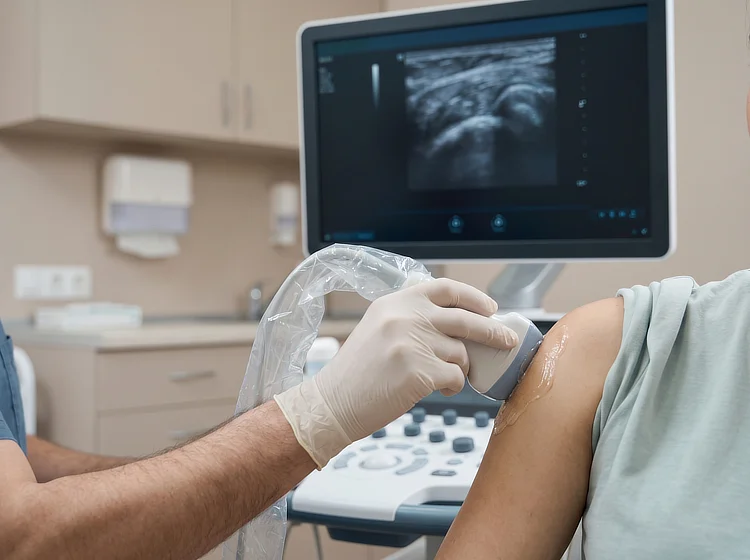
The ultrasound guides the needle, while the substance injected, such as a corticosteroid
(cortisone), hyaluronic acid or platelet-rich plasma (PRP), treats the condition. This means
the same injection can be given with or without ultrasound.
Without ultrasound, the needle is placed by feeling for landmarks such as bones under the
skin, and its tip cannot be seen. Large joints that are easy to reach, such as the knee, are
often injected this way.
Ultrasound is usually used when the target is small or deep, such as the hip joint or the sheath around a
finger tendon, or when it lies close to nerves and blood vessels that the needle must avoid.
Types of Ultrasound-Guided Injections
The common types of injections that may use ultrasound guidance are cortisone, H&L, hyaluronic acid and PRP injections, nerve blocks and nerve hydrodissection. Each uses a different medicine or fluid to treat pain.
Cortisone Injection
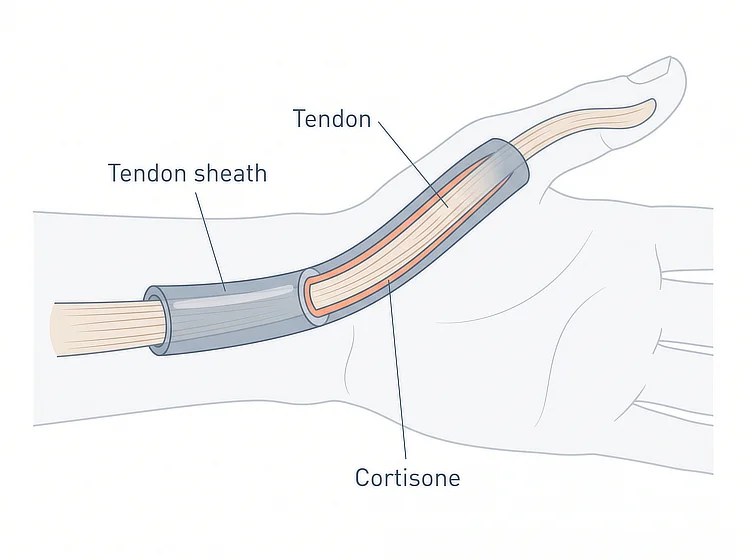
A cortisone injection delivers a corticosteroid, a man-made version of the body's own
anti-inflammatory hormone cortisol, into an inflamed joint, bursa or tendon sheath to reduce
pain and swelling. Relief usually begins within a few days, but it can take up to a
week.
Ultrasound helps place the medicine around a tendon rather than into it, as a corticosteroid
injected directly into a tendon can weaken
it.
H&L Injection
An H&L injection combines
hydrocortisone, a corticosteroid, with lignocaine, a local anaesthetic. The lignocaine numbs the
area within minutes, while the hydrocortisone reduces
inflammation over the following days.
Ultrasound helps with small targets, such as the narrow tendon sheaths of the thumb and fingers.
Hyaluronic Acid Injection
Hyaluronic acid is a gel-like substance found naturally in joint fluid, where it cushions and
lubricates the joint. In osteoarthritis, this fluid becomes thinner,
and a hyaluronic acid injection, also called a knee gel injection, supplements it.
Ultrasound confirms that the needle is inside the joint space, particularly in deep joints such as
the hip.
Platelet-Rich Plasma (PRP) Injection
PRP is made from a small sample of your own blood, which is spun in a machine called a centrifuge to
concentrate the platelets. Platelets release growth
factors, proteins that may help injured tendons, ligaments and muscles heal.
Ultrasound shows the damaged part of the tendon or ligament, so the PRP can be injected directly into
it.
Nerve Block
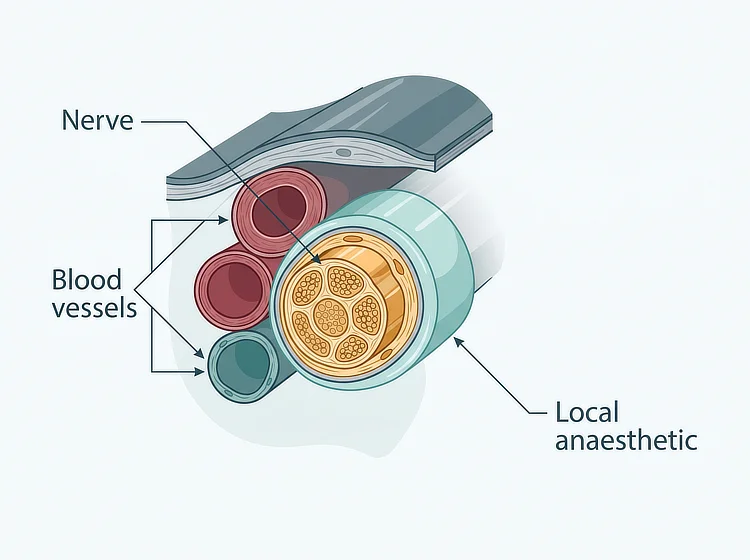
A nerve block is an injection of local anaesthetic, sometimes with a corticosteroid, next to
a nerve to temporarily block the pain signals
it carries. It can also help find which nerve is causing the pain.
Nerves and blood vessels can be seen on ultrasound, so the needle can be placed beside the
nerve while avoiding the nerve itself. Blocks near the spine may be guided by live X-ray
(fluoroscopy) instead.
Nerve Hydrodissection
Nerve hydrodissection is an injection of fluid around a trapped nerve to separate it from the tissue
pressing on it. The fluid is usually a sterile salt solution (normal saline) or dextrose, a weak
sugar solution.
Ultrasound is used throughout the procedure, as the fluid must be seen spreading around the nerve to
free it.
Conditions Treated With Ultrasound-Guided Injections
Ultrasound-guided injections are used for pain in the joints, tendons, ligaments, muscles and nerves, and the type of injection depends on the condition. Some conditions, such as plantar fasciitis, can be treated with more than one type.
| Type of Injection | Common Conditions Treated |
|---|---|
| Cortisone Injection |
|
| H&L Injection |
|
| Hyaluronic Acid Injection |
|
| Platelet-Rich Plasma (PRP) Injection |
|
| Nerve Block |
|
| Nerve Hydrodissection |
|
 Unsure which treatment is most suitable for your pain? Book a
consultation for an assessment and a plan built around your condition and your
activities.
How Is an Ultrasound-Guided Injection Performed?
An ultrasound-guided injection is usually performed in a single clinic visit, with the scan used first to find the target and then to guide the needle:
1. Scanning the Area
The painful area is scanned to locate the joint, tendon, bursa or nerve to be treated, along with the nerves and blood vessels near it.
2. Preparing the Skin
The skin is cleaned, and the ultrasound probe is placed in a sterile cover. A local anaesthetic may be used to numb the skin.
3. Guiding the Needle
A thin needle is inserted beside the probe and shows on the screen as a bright line, so it can be directed to the target while avoiding nearby nerves and blood vessels.
4. Injecting the Medicine
Once the needle tip is in place, the medicine is injected and can be seen spreading on the screen. The needle can be adjusted if the medicine does not spread where intended.
The injection itself usually takes a few minutes, but some steps differ with the type of injection.
For PRP, your blood is drawn and prepared before the scan, so the visit may take longer. For nerve
hydrodissection, the fluid is watched as it separates the trapped nerve from the tissue around it.
Ultrasound-Guided Injection Cost in Singapore
At Apex Sports Clinic, we offer ultrasound-guided injections, with prices as follows:
| Treatment & Service | Estimated Cost (SGD)* |
|---|---|
| Initial Consultation | From $200 |
| Follow-Up Consultation | From $150 |
| Ultrasound Guidance for Injections (in addition to cost of injection) | From $150 |
| Injection Treatments | |
| Cortisone Injection | From $250 per injection |
| H&L Injection | From $250 per injection |
| Hyaluronic Acid Injection | From $1,000 per injection |
| Platelet-Rich Plasma (PRP) Injection | From $1,000 per injection |
| Nerve Block | From $3,000 |
| Nerve Hydrodissection | From $150 |
| Diagnostic Services | |
| Ultrasound Imaging | From $100 |
MediSave coverage depends on the type of injection, not on the ultrasound guidance. Outpatient injections, such as cortisone, hyaluronic acid and PRP, are generally not MediSave-claimable, but some Integrated Shield Plans or private insurance policies may cover part of the cost. It is best to check with your insurer or employer benefits provider before treatment.
*Prices listed above are estimates and may vary depending on the complexity of the condition, type of procedure, and other clinical considerations.
Find Ultrasound-Guided Injection Near Me
Apex Novena
Why Do Patients Choose Apex Sports Clinic?
Sports Doctor in Singapore: Personalised & Affordable Care
One-Stop Sports Clinic
We provide comprehensive care in one clinic, from consultation, imaging, and injections through to physiotherapy, sports massage, and surgery when needed.
Keyhole Surgery Expertise
We specialise in arthroscopic keyhole surgery to treat sports injuries with precision and minimal tissue disruption, supporting faster recovery and restored joint function.
Specialist in Sports Injury Management
We combine evidence-based injury management with a proactive approach to maintaining your body's strength and function, so you can recover fully and perform at your peak.
Patient Journey
1 . Schedule Your Appointment

2 . Expert Diagnosis & Consultation

3 . Customised Treatment Plan

Schedule an Appointment

Our Insurance Partners




Frequently Asked Questions (FAQs)
Ultrasound-guided injections are performed by doctors trained in musculoskeletal ultrasound, the use of ultrasound to view muscles, tendons, joints and nerves. These commonly include sports medicine doctors, orthopaedic surgeons, pain specialists and radiologists (doctors who specialise in medical imaging). Physiotherapists do not usually give the injection, although they often guide the exercises that follow it. At Apex Sports Clinic, ultrasound-guided injections are performed by our orthopaedic specialists, sports medicine doctors and pain specialists.
Ultrasound-guided injections can ease pain for many people, but how well they work depends mainly on the medicine injected and the condition being treated, rather than on the ultrasound, which guides the needle to the right spot. A corticosteroid (cortisone), an anti-inflammatory medicine, may ease pain and swelling within days, with relief that often lasts a few weeks to a few months. Platelet-rich plasma (PRP), made from a sample of the patient's own blood, tends to act gradually over several weeks. Results also vary with how severe the condition is and how long it has been present.
An ultrasound-guided injection usually causes mild, brief discomfort, similar to a blood test or vaccination. A local anaesthetic may be used to numb the skin first, and a feeling of pressure or tightness is common as the medicine fills the joint or the space around a tendon. The needle can be seen on the screen throughout, so it can usually reach the target with little repositioning, which helps limit discomfort. The area may ache for a day or two once any anaesthetic wears off.
Recovery time after an ultrasound-guided steroid injection is determined mainly by the anti-inflammatory steroid (corticosteroid) and the area treated, not by the ultrasound guidance. Light daily activities can typically resume the next day, and the injection site may ache for one to two days. Some people have a steroid flare, a temporary increase in pain that typically lasts two to three days. Pain relief usually begins within a few days, but it can take up to a week. A return to sport or heavy work is generally gradual over the following weeks.
The risks of ultrasound-guided injections come mainly from the medicine injected and the needle, not from the ultrasound. Soreness and bruising at the injection site are the most common. A corticosteroid (cortisone), an anti-inflammatory medicine, can cause a flare of pain, skin lightening, a temporary rise in blood sugar in people with diabetes and, rarely, weakening of a nearby tendon. Infection is rare when the skin is cleaned and sterile equipment is used. Ultrasound may lower the risk of injuring a nerve or blood vessel, as both can be seen and avoided on the screen.
Driving after an ultrasound-guided injection depends on the type of injection and the area treated, not on the ultrasound. A local anaesthetic can numb the treated arm or leg for a few hours, which may affect control of the car, so driving is often not advised for the rest of that day. A nerve block, an injection that temporarily stops a nerve from carrying pain signals, can cause numbness or weakness that lasts longer. You should always follow your doctor's advice on whether you can drive home.
The success of ultrasound-guided injections depends mainly on the type of injection and the condition treated, not on the ultrasound itself, so there is no single success rate. The ultrasound's role is to help the medicine reach the intended joint, tendon or nerve, particularly in small or deep areas such as the hip or the tendons of the fingers. Relief is more likely when a condition is treated at a mild to moderate stage. It may also last longer when the injection is combined with physiotherapy, which strengthens the area and can address the cause of the pain.
The cost of an ultrasound-guided injection is made up of the injection itself and a separate fee for the ultrasound guidance. At Apex Sports Clinic, we offer ultrasound guidance for injections from $150, in addition to the cost of the injection: cortisone (steroid) injection from $250, H&L injection from $250, hyaluronic acid injection from $1,000 and platelet-rich plasma (PRP) injection from $1,000 per injection. An initial consultation starts from $200. Prices are estimates and may vary with the condition and the procedure.
Aftercare for an ultrasound-guided injection varies with the type of injection, not with the ultrasound. The plaster or dressing can typically be removed after 24 hours, and an ice pack or simple pain relief, such as paracetamol, can ease soreness. After a corticosteroid (cortisone) injection, people with diabetes are often advised to check their blood sugar more often for about five days. After a platelet-rich plasma (PRP) injection, anti-inflammatory painkillers such as ibuprofen are often avoided, as they may interfere with the healing PRP aims to support. You should always follow your doctor's aftercare instructions, which are based on the injection you received.