
A Guide to Plyometric Exercises for Athletes and Beginners
Information reviewed by: Dr Foo Gen Lin | Last updated:
Looking to improve your athletic performance or return to sport after an injury? Dr Foo Gen Lin provides assessment and guidance on plyometric training programmes tailored to your sport, fitness level, and recovery goals.

MBBS (University of London) | MMed (Ortho) | FRCSEd (Ortho) | FAMS (Ortho)

What Are Plyometric Exercises?
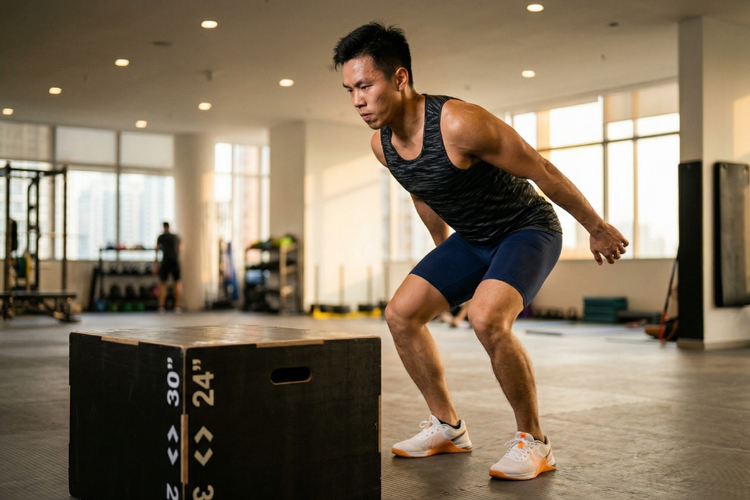
Plyometric exercises are explosive, jump-based movements that train your muscles to
produce maximum force in short bursts.
They work through a mechanism
known as the stretch-shortening cycle, which teaches your muscles and tendons to store and
release elastic energy more efficiently.
You encounter plyometric movements in
everyday sports without realising it. A basketball player jumping for a rebound, a sprinter
pushing off the blocks, or a footballer changing direction at speed are all using plyometric
principles. Training these patterns in a structured way improves the speed and power behind
those movements.
Plyometrics differ from standard strength training because the focus is on how quickly you generate force, not just how much force you produce. A squat builds raw strength; a squat jump builds the ability to apply that strength explosively.
How Plyometric Exercises Work
The stretch-shortening cycle is the mechanism behind every plyometric movement. It occurs in three phases:
Eccentric Phase (The Loading)
When you land from a jump or drop into a squat position, your muscles stretch under load. This activates a reflex response and stores elastic energy in your tendons, much like pulling back a rubber band.
Amortisation Phase (The Transition)
This is the brief moment between landing and taking off again. The shorter this phase, the more stored energy you carry into the next movement.
Concentric Phase (The Explosion)
Your muscles contract rapidly, releasing the stored elastic energy to propel you upward or forward.
Benefits of Plyometric Exercises
Plyometric exercises improve athletic power, speed, and agility across a wide range of sports. Beyond explosive performance, they play a role in injury prevention and offer several benefits that support long-term musculoskeletal health.
- Increased vertical jump height — Improves force production and tendon elasticity, particularly relevant for basketball, volleyball, and high jump
- Improved sprint speed — Develops the ability to generate ground-reaction force more quickly, relevant across nearly all field and court sports
- Improved agility and change of direction — Particularly important in sports that involve cutting, pivoting, and reactive movement
- Better neuromuscular control — Trains the muscles around joints like the knee and ankle to react and stabilise more quickly, reducing the risk of non-contact injuries
- Tendon resilience — Strengthens tendons through controlled loading and may support recovery from conditions like patellar tendinopathy and Achilles tendonitis
- Greater bone density — High-impact loading stimulates bone growth and strengthening, which may help reduce the risk of stress fractures over time
Types of Plyometric Exercises
Plyometric exercises range from low-intensity movements suitable for beginners to high-intensity drills designed for trained athletes. They are typically categorised by the body region they target and their intensity level.
Lower Body Plyometrics
Lower body plyometrics make up the majority of plyometric training and target the muscles of the hips, thighs, and calves.
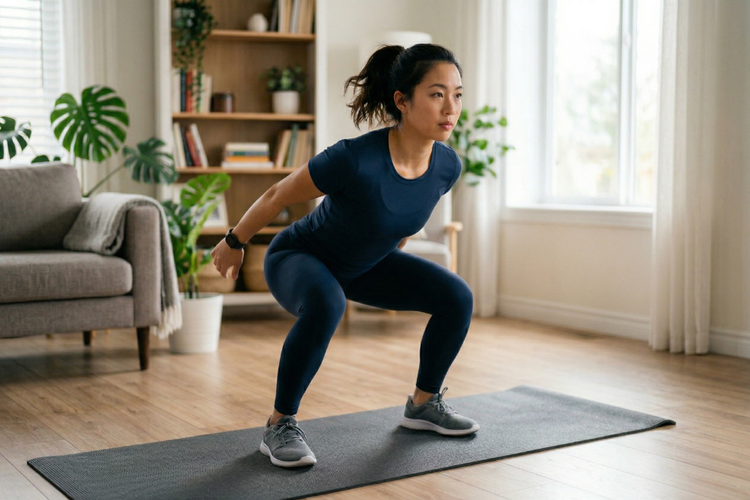
Squat Jumps
What it is: Jumping explosively from a squat position and landing softly
back into the squat. A foundational exercise suitable for beginners.
What
it develops: Lower-body power, particularly in the quadriceps and glutes.
Box Jumps
What it is: Jumping onto a raised platform, landing at a higher elevation to reduce
impact. Box height can be adjusted to match your ability.
What it
develops: Explosive leg power and hip extension with lower landing stress than
ground-based jumps.
Depth Jumps
What it is: Stepping off a box, landing briefly, and immediately jumping upward. An
advanced drill that maximises the stretch-shortening cycle.
What it
develops: Reactive strength and the ability to absorb and redirect force rapidly.
Bounding
What it is: An exaggerated running stride where you push off forcefully with each
step, covering as much distance as possible.
What it develops: Sprint
power and horizontal force production through the hips and glutes.
Lateral Hops
What it is: Hopping side to side over a line or small obstacle.
What
it develops: Lateral explosiveness and stability for sports involving cutting and quick
directional changes.
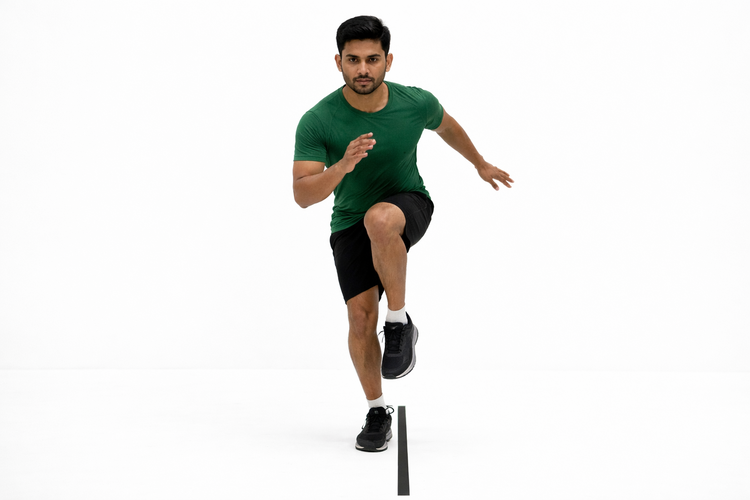
Single-Leg Hops
What it is: Repeated hops performed on one leg.
What it
develops: Unilateral power and balance. Also particularly useful in
rehabilitation and for identifying strength imbalances between legs.
Upper Body Plyometrics
Upper body plyometrics are less common but useful for sports that demand explosive arm and chest movements, such as throwing, punching, or pushing.
Plyometric Push-Ups
What it is: Pushing off the ground with enough force for your hands to leave the
surface, then landing and immediately lowering into the next repetition.
What it
develops: Explosive chest, shoulder, and tricep power.
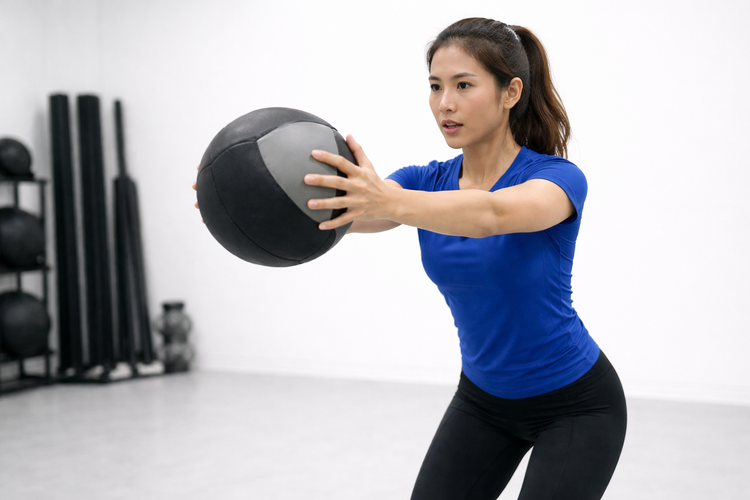
Medicine Ball Chest Passes
What it is: Throwing a weighted ball explosively against a wall or to a
partner.
What it develops: Rapid force production through the
chest and shoulders.
Overhead Medicine Ball Slams
What it is: Throwing a weighted ball forcefully downward from overhead.
What it develops: Power through the core, shoulders, and arms in a forceful overhead throwing motion.
 Recovering from a sports injury and unsure if plyometric training is right for
you? Our sports
doctors can assess your condition and guide you through a structured return-to-sport
programme.
Recovering from a sports injury and unsure if plyometric training is right for
you? Our sports
doctors can assess your condition and guide you through a structured return-to-sport
programme.
Best Plyometric Exercises for Specific Goals
Plyometrics for Speed
Plyometric exercises for speed train the muscles to produce horizontal force more efficiently,
improving acceleration and top-end pace.
Best suited for: Sprinters,
football players, and field-sport athletes.
Key exercises: Bounding, broad
jumps, and single-leg hops train the muscles to push the body forward rather than upward.
Plyometrics for Vertical Jump
Plyometric exercises for vertical jump train the muscles to produce maximal upward force as quickly
as possible, increasing jump height and hang time.
Best suited for:
Basketball players, volleyball players, and high jumpers.
Key exercises:
Depth jumps, squat jumps, and tuck jumps focus on maximising vertical displacement.
Plyometrics for Runners
Plyometric exercises for runners improve
running economy, which is the energy your body uses to maintain a given pace. These
improvements are linked to better lower-limb stiffness, the ability of your tendons to store and
return energy with each stride. Plyometric training has been shown to be particularly effective at
moderate running speeds.
Start with low volumes (30 to 40 foot contacts per session) and
build gradually, particularly if you are increasing your weekly mileage at the same time.
Best suited for: Distance runners, middle-distance runners, and recreational
runners.
Key exercises: Pogo hops, single-leg hops, and drop jumps at low
to moderate heights help the calves and Achilles tendon handle ground contact more efficiently.
Plyometrics for Beginners
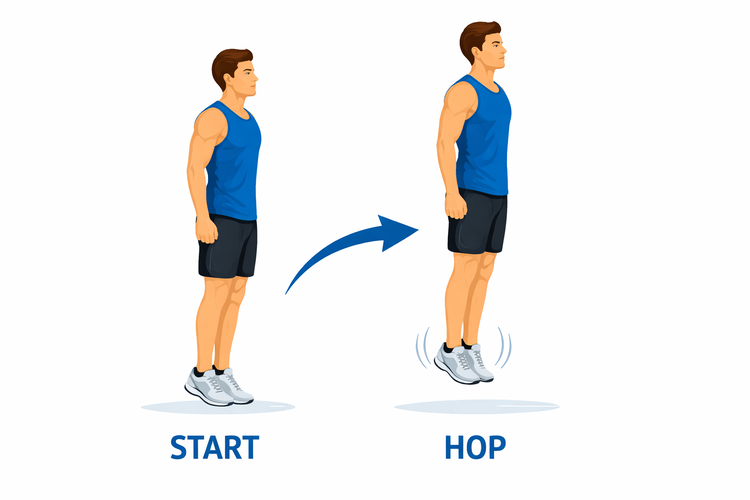
If you are new to plyometric training, start with low-intensity exercises that teach proper
landing mechanics before progressing to higher-impact drills.
Spending 4 to 6 weeks
on low-intensity foundational movements allows your tendons, bones, and muscles to adapt to
the impact demands of plyometric training. Skipping this preparation phase increases the
risk of overuse injuries such as shin splints or tendon irritation.
Key
exercises: Pogo hops, squat jumps at less than full effort, box jumps onto a
low platform (30 to 40 cm), and lateral line hops over a line on the ground.
Plyometrics for Older Adults
Older adults can benefit from modified, lower-impact plyometric exercises that improve balance, reaction time, and strength for
everyday activities. These movements may help maintain bone density and lower-limb strength,
both of which decline with age.
Plyometric-based balance training has also been linked to
reduced fall risk, making it a practical addition to an active ageing programme.
Key
exercises: Seated medicine ball throws, wall push-offs, and small bilateral hops on a
cushioned surface provide a plyometric stimulus with reduced joint stress.
How to Do Plyometric Exercises Correctly
Learning how to do plyometric exercises correctly is essential for maximising performance
and reducing the risk of injury. Always warm up before every plyometric session to
prepare your muscles and joints for high-impact loading.
Take note of:
- Landing mechanics — Poor landing technique places excessive stress on the joints and ligaments, and is a common cause of non-contact knee injuries in sport
- Ground contact time — Spending too long on the ground between landing and takeoff allows stored elastic energy to dissipate, reducing the explosive training effect
- Progression — Advancing too quickly to high-intensity drills without building a foundation of strength and technique increases the risk of overuse injuries to the joints, tendons, and bones
Who Should Avoid Plyometric Exercises?
Plyometric exercises involve high-impact forces and are not suitable for everyone without modification. You should approach plyometric training with caution or seek guidance from a sports medicine professional if you have:
- Recent surgery on the lower limbs — plyometrics are typically reintroduced during the later stages of rehabilitation under professional supervision
- Active joint injuries — such as ankle sprains, meniscus tears, or acute hamstring injuries that have not fully healed
- Osteoporosis with high fracture risk — where the impact forces may exceed what the bones can tolerate
- Osteoarthritis in weight-bearing joints — particularly the knees or hips, where high-impact loading may aggravate symptoms
- Insufficient lower-limb strength — as inadequate muscular support increases the risk of joint and tendon injuries during landing
If you are recovering from a musculoskeletal injury and want to incorporate plyometric exercises into your rehabilitation, a structured and supervised programme can help you return to dynamic activities progressively.
Plyometric exercises play an important role in both performance training and rehabilitation. When introduced at the right stage with proper technique, they help rebuild confidence in explosive movements and reduce the risk of re-injury.
Dr Foo Gen Lin
Find a Sports Doctor in Singapore
Apex Novena
Why Do Patients Choose Apex Sports Clinic?
Sports Doctor in Singapore: Personalised & Affordable Care
One-Stop Sports Clinic
We provide comprehensive care in one clinic, from consultation, imaging, and injections through to physiotherapy, sports massage, and surgery when needed.
Keyhole Surgery Expertise
We specialise in arthroscopic keyhole surgery to treat sports injuries with precision and minimal tissue disruption, supporting faster recovery and restored joint function.
Specialist in Sports Injury Management
We combine evidence-based injury management with a proactive approach to maintaining your body's strength and function, so you can recover fully and perform at your peak.
Patient Journey
1 . Schedule Your Appointment

2 . Expert Diagnosis & Consultation

3 . Customised Treatment Plan

Schedule an Appointment

Our Insurance Partners




Frequently Asked Questions (FAQs)
Plyometric exercises are primarily used to develop explosive power, speed, and agility. They train the muscles to produce maximum force in short bursts by using the stretch-shortening cycle, which improves how efficiently your muscles and tendons store and release elastic energy. Beyond athletic performance, plyometrics may also support neuromuscular control, tendon resilience, and bone density, making them relevant for both sport-specific training and injury prevention programmes.
Suitable beginner plyometric exercises include pogo hops, squat jumps at less than full effort, box jumps onto a low platform (30 to 40 cm), and lateral line hops over a line on the ground. These low-intensity movements help develop proper landing mechanics and allow your tendons, bones, and muscles to adapt to the impact demands of plyometric training. Spending 4 to 6 weeks on these foundational exercises before progressing to higher-intensity drills is generally recommended.
The right volume depends on your training experience and the intensity of the exercises. A good starting point for beginners is around 3 exercises for 60 to 80 total foot contacts per session, while more experienced athletes may work up to 4 or 5 exercises for 100 to 140 foot contacts. Foot contacts are a more useful measure than sets and reps alone, since a single depth jump places far more stress on the body than a pogo hop.
Most guidelines recommend 1 to 3 plyometric sessions per week depending on your training level, with at least 48 hours of rest between sessions to allow your muscles and tendons to recover. A good starting point for beginners is 1 to 2 sessions per week, while more experienced athletes can train up to 3 times per week. Plyometric sessions are typically scheduled alongside speed or power work rather than on heavy strength-training days.
Plyometric exercises primarily develop power and speed rather than muscle size. They activate a high number of muscle fibres but use fast, explosive repetitions with relatively low time under tension, which differs from the higher volume and slower tempos typically used in hypertrophy-focused training. Beginners may notice some muscle development in the calves, quadriceps, and glutes as a new training stimulus, but for building muscle mass, plyometrics work better as a complement to traditional strength training.
Plyometric exercises elevate your heart rate significantly due to their explosive, high-intensity nature, which makes them a form of high-intensity cardiovascular training. Performing multiple plyometric exercises back to back can improve both anaerobic and aerobic fitness simultaneously. However, they are not a substitute for sustained aerobic exercise like running or cycling, as the work intervals are short and the primary training goal is power and speed rather than cardiovascular endurance.
Plyometric exercises are widely used in injury prevention programmes, particularly for reducing the risk of non-contact knee and ankle injuries. They improve how quickly the muscles around a joint activate in response to unexpected forces, such as an awkward landing or sudden change of direction. Neuromuscular training programmes that include plyometrics have been associated with reduced ACL injury rates in athletes. For those with existing injuries, it is advisable to consult a sports medicine professional before starting plyometric training.
The key difference is that strength training focuses on how much force your muscles can produce, typically using slower, controlled movements with heavier loads, while plyometric training focuses on how quickly you can produce force, using explosive movements that train the stretch-shortening cycle. A squat builds raw strength, while a squat jump builds the ability to apply that strength explosively. The two approaches complement each other and are often combined in athletic training programmes.
A basic level of lower-limb strength is recommended before starting plyometric training, as inadequate muscular support increases the risk of joint and tendon injuries during landing. A common guideline suggests being able to squat 1.5 times your body weight before performing high-intensity plyometrics such as depth jumps, though this threshold is not universally agreed upon. Lower-intensity drills like pogo hops and box jumps onto a low platform can be started earlier without meeting this requirement.
Football demands rapid acceleration, deceleration, and frequent changes of direction, making plyometrics particularly relevant. Useful exercises include bounding and broad jumps to develop sprint power, lateral hops to improve cutting and directional changes, and single-leg hops to build unilateral strength and balance. Depth jumps and squat jumps can also help develop the explosive leg power needed for tackling, jumping for headers, and recovering speed after a change of direction.
Basketball relies heavily on vertical explosiveness, quick lateral movement, and reactive agility. Depth jumps and squat jumps train the muscles to produce maximal upward force for rebounding and shot-blocking. Lateral hops improve the side-to-side quickness needed for defensive positioning, while tuck jumps develop hang time and mid-air body control. Single-leg hops are also useful for building the unilateral power required for layups and driving to the basket.
A plyometric workout is a structured training session built around explosive, jump-based exercises that use the stretch-shortening cycle to develop power, speed, and agility. A typical session includes a thorough warm-up, followed by around 3 to 5 plyometric exercises performed for a set number of foot contacts rather than just sets and reps. Sessions are kept relatively short and high in intensity, with adequate rest between sets to maintain movement quality throughout the workout.
Yes, 20 minutes is generally sufficient for a plyometric session. Plyometric training prioritises quality and intensity over duration, with most sessions consisting of around 3 to 5 exercises performed at high effort with adequate rest between sets. Longer sessions can lead to fatigue, which increases the risk of poor landing mechanics and injury. The total number of foot contacts per session is a more useful measure of training volume than time alone, with beginners typically aiming for 60 to 80 contacts.
Four commonly used plyometric exercises are squat jumps, box jumps, lateral hops, and medicine ball chest passes. Squat jumps and box jumps develop lower-body explosive power and are suitable for a range of fitness levels. Lateral hops train side-to-side reactivity for sports involving cutting and directional changes. Medicine ball chest passes target the upper body, training the chest and shoulders to produce rapid force. These exercises cover both lower and upper body plyometric training.
High-impact plyometric exercises that generate significant ground-reaction forces are most associated with improvements in bone density. Jumping exercises such as squat jumps, countermovement jumps, and multidirectional hops have been shown to stimulate bone growth and strengthening, particularly at the hip and lumbar spine. Even simple routines involving as few as 10 jumps performed several times per week may produce measurable benefits. If you have osteoporosis or low bone density, you should consult a doctor before starting plyometric training.
Plyometric exercises involve high-impact forces that place significant stress on the joints, tendons, and bones. Without proper technique, adequate strength, or sufficient recovery between sessions, there is an increased risk of overuse injuries such as shin splints, tendon irritation, and joint stress. They are not suitable for everyone without modification, particularly those with active joint injuries, recent surgery, or osteoporosis with high fracture risk. A gradual progression from low to high intensity is essential to reduce these risks.
Plyometric training is well supported by research for improving vertical jump height, sprint speed, agility, and neuromuscular control across a wide range of sports and populations. These improvements result from specific adaptations including more efficient muscle fibre recruitment, improved tendon elasticity, and better stretch-shortening cycle function. Results depend on consistent training, appropriate programming, and sufficient recovery. Most structured programmes have been shown to produce measurable improvements in explosive performance.
Daily plyometric training is generally not recommended. Plyometric exercises place high demands on the muscles, tendons, and joints, and generally require 48 to 72 hours of recovery between sessions for adequate tissue repair and adaptation. Training on fatigued muscles increases the risk of poor landing mechanics and overuse injuries. Most guidelines recommend 1 to 3 sessions per week depending on training level and intensity, with plyometrics scheduled on days when the body is fresh rather than fatigued.
Plyometric exercises are most effective when performed at the start of a training session or on days dedicated to speed and power work, when the body is fresh and not fatigued. Training on fatigued muscles reduces jump height, slows reaction time, and increases the risk of poor landing mechanics. Avoid scheduling plyometrics immediately after heavy strength-training sessions. A thorough warm-up before every plyometric session is essential to prepare the muscles and joints for high-impact loading.
The most common plyometric mistakes include poor landing mechanics, insufficient rest between sessions, and progressing too quickly to high-intensity drills. Landing with the knees collapsing inward places excessive stress on the knee ligaments, particularly the ACL. Spending too long on the ground between landing and takeoff reduces the training effect by allowing stored elastic energy to dissipate. Skipping the foundational preparation phase also increases the risk of overuse injuries such as shin splints and tendon irritation.
Depth jumps are widely considered the most intense plyometric exercise. They involve stepping off a raised platform, landing briefly, and immediately jumping upward with maximum effort. This movement maximises the stretch-shortening cycle by combining a high eccentric load with a rapid concentric contraction, placing significant demand on the muscles, tendons, and joints. Depth jumps are an advanced drill and should only be attempted after building a solid foundation of lower-intensity plyometric exercises and adequate lower-limb strength.
Modified, lower-impact plyometric exercises may benefit older adults by improving balance, reaction time, and strength for everyday activities. Plyometric training in older adults has been associated with improvements in muscular strength, postural stability, and reduced fall risk. These movements may also help maintain bone density and lower-limb strength, both of which decline with age. It is advisable to consult a healthcare professional before starting, and supervised sessions are recommended.
Weighted plyometric exercises add external resistance to explosive movements to further develop power. Common examples include weighted squat jumps using a barbell or dumbbells, medicine ball overhead slams, and medicine ball chest passes. These exercises combine the speed demands of plyometrics with the loading principles of strength training. They are generally suited to intermediate and advanced athletes who have already mastered bodyweight plyometric technique, as the added load increases joint stress.
Beginners can safely incorporate low-intensity plyometric exercises into their training with appropriate progression. Starting with foundational movements such as pogo hops, squat jumps at less than full effort, and box jumps onto a low platform allows the tendons, bones, and muscles to adapt to the impact demands gradually. Spending around 4 to 6 weeks on these exercises before progressing to higher-intensity drills helps reduce the risk of overuse injuries. Focusing on proper landing mechanics from the outset is particularly important for beginners.